Bank Statement Analysis: A UK Household Savings Guide
18 August 2026 · 17 min read
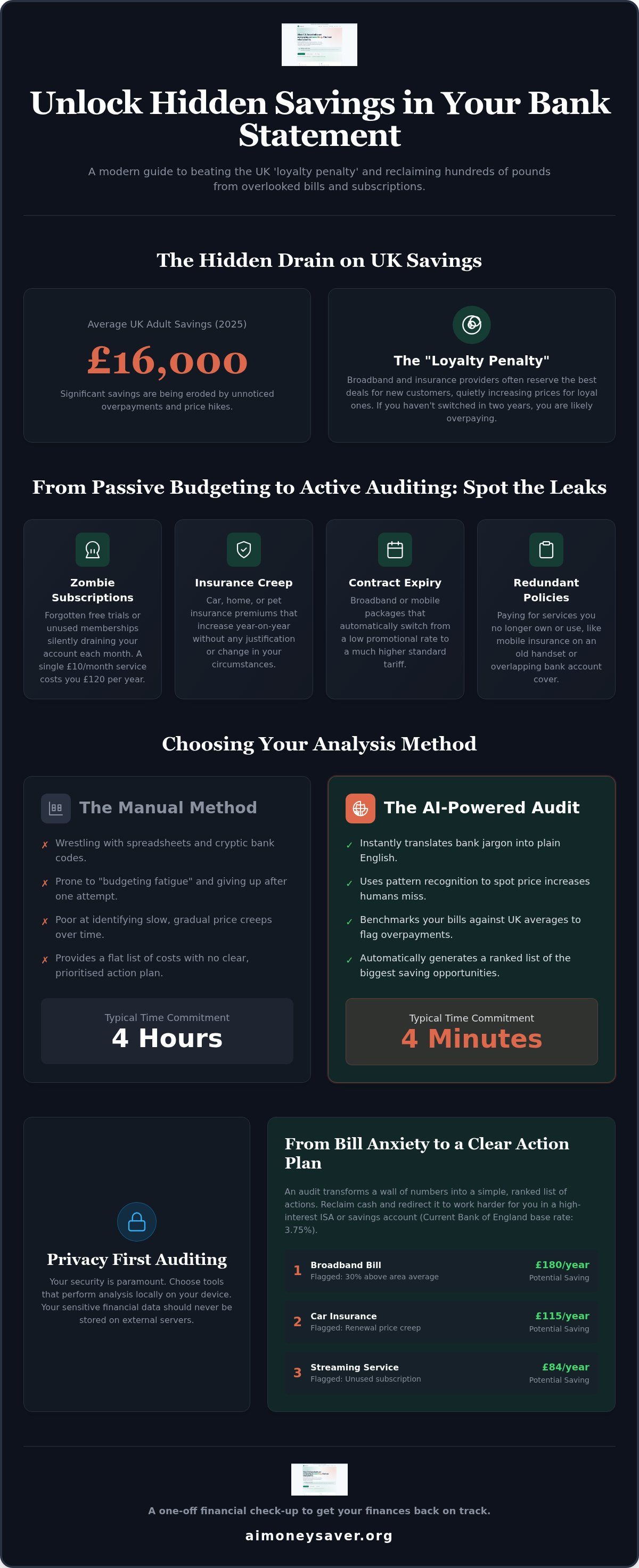
According to 2025 data from MoneySuperMarket, the average UK adult has £16,000 in savings, yet many are losing hundreds every year to the "loyalty penalty" on broadband and insurance. It's a quiet tax on your time. Performing a regular bank statement analysis for savings is the fastest way to spot these leaks before they drain your account. You likely feel a sense of "bill anxiety" when looking at your transactions. That's normal. Most people see a wall of numbers and costs they feel they can't change.
We agree that your money should work harder, especially with the Bank of England base rate currently at 3.75%. This guide will show you how to transform your monthly statement into a personalised roadmap for reclaiming overpaid bills and hidden household savings. If you identify the right leaks, you can redirect that cash into a high-interest ISA or a better-performing savings account. We'll walk through how to rank your savings actions, eliminate "zombie" subscriptions, and use secure methods that keep your sensitive data on your own device. It's a simple, one-time check-up to get your finances back on track.
Key Takeaways
- Stop paying the "loyalty penalty" by identifying where UK broadband and insurance providers are overcharging you for staying put.
- Perform a systematic bank statement analysis for savings to spot hidden "zombie" subscriptions and billing errors that manual spreadsheets often miss.
- Protect your financial privacy by choosing tools that process data locally on your device instead of storing sensitive transactions on external servers.
- Create a ranked list of savings actions to reclaim overpayments and move your cash into higher-interest accounts or ISAs.
- Replace "bill anxiety" with a clear roadmap using a one-off financial check-up that avoids the trap of ongoing subscription fees.
Why Your Bank Statement is the Secret to Reducing UK Household Bills
Most people view their bank statement as a record of what's already gone. That's a mistake. A proper bank statement analysis for savings is a systematic audit of your transactions to find overpayments you didn't even know you were making. It's the difference between passive budgeting and active auditing. Passive budgeting tells you that you spent £50 on coffee. Active auditing tells you that you're paying £20 a month too much for broadband because your contract ended six months ago.
In the UK, we face a "loyalty penalty". Providers often offer the best rates to new customers and quietly hike prices for the rest of us. If you haven't switched your car insurance or home broadband in two years, you are likely paying a premium just for staying put. A single audit can reveal hundreds of pounds in annual savings by highlighting these price creeps. It's a pragmatic way to reclaim your cash without needing a second job or a complex investment strategy.
The Problem with Generic Banking Apps
Modern banking apps love colourful charts. They show you "Coffee vs. Groceries" categories. This rarely helps you save significant money. Knowing you spent money on lunch doesn't stop the £15 monthly price hike on your SIM-only deal. These apps fail to flag when you've slipped out of a fixed-term contract. They also create a psychological burden with constant notifications. A one-off audit is different. It provides a clear list of actions without the daily nag. It focuses on the big wins rather than the small change.
What an Audit Can Reveal
A thorough bank statement analysis for savings uncovers the hidden leaks in your domestic sphere. By looking at your spending through a critical lens, you can spot several common drains on your finances:
- Zombie subscriptions: Services you forgot to cancel whilst on a free trial or memberships you no longer use.
- Insurance creep: Premiums for car, home, or pet insurance that have increased year-on-year without any change in your circumstances.
- Contract expiry: Utility and broadband packages that have moved from a promotional rate to a standard variable tariff.
- Redundant policies: Paying for mobile phone insurance on a handset you traded in months ago or overlapping cover on bank accounts.
These small leaks add up. By cross-referencing your payments with your actual needs, you reclaim control over your household budget. This isn't about cutting out life's little luxuries. It's about stopping the flow of money to companies that no longer earn it. If you find one "zombie" subscription for £10 a month, that's £120 back in your pocket every year. If you find three, you've just paid for your next weekend away.
Manual vs. AI: Choosing the Best Way to Analyse Your Spending
Manual auditing is a chore. Most people spend four hours on a Sunday afternoon wrestling with a spreadsheet. They download CSV files. They copy and paste rows. They try to remember what a specific transaction from three months ago was for. By the time the data is organised, they're too tired to actually act on it. This leads to "budgeting fatigue". You do it once, feel overwhelmed, and never look at it again. The effort outweighs the reward.
AI changes the maths. A digital bank statement analysis for savings takes about four minutes. It doesn't get bored. It doesn't miss the annual car insurance payment buried in last November's transactions. The human eye is good at spotting big, one-off purchases. It is significantly worse at identifying slow price creeps over a twelve-month period. AI pattern recognition solves this by looking at the trajectory of your bills, not just the individual cost.
The Spreadsheet Struggle
UK banks use cryptic transaction codes that make manual entry difficult. "SKY-UK-0800" or "DVLA-V11" aren't always obvious. In a standard Excel sheet, these are just strings of text. There is no "ranked action" telling you which bill to tackle first. You are left with a flat list of costs and no clear starting point. Most people give up after the first month because the process feels like a second job with very little immediate payoff.
How Modern AI Auditing Works
Modern tools use Natural Language Processing (NLP) to translate bank jargon into plain English. They know exactly what "SKY-UK-0800" represents. The software can then benchmark your spending against typical UK household averages. If your broadband bill is 30% higher than the average for your speed, the AI flags it as a priority. It ranks savings by "ease of execution". Instead of just seeing a list of expenses, you get a roadmap of which providers to call first for the biggest wins.
Accuracy is the primary benefit here. Manual checks often miss quarterly or annual direct debits that only appear once or twice a year. AI scans your entire history in seconds to find these hidden leaks. If you want a clear view of your spending without the weekend-long headache, you can start a bank statement check to see what your data reveals. It is a pragmatic way to get the facts without the friction. It's about finding the most efficient path to a better bank balance.
The Three-Step Audit: Spotting Loyalty Penalties and Overpayments
Performing a bank statement analysis for savings requires a systematic approach. You shouldn't just look for large numbers. You need to look for patterns. A proper audit follows three distinct steps to isolate waste and identify where you are being overcharged. By categorising your spend and cross-referencing it with your actual usage, you create a ranked list of actions. This ensures you tackle the biggest wins first, such as high-cost insurance or broadband, before moving to smaller items like streaming services.
Step 1 involves categorising your recurring fixed costs. Focus on the "big four": Broadband, TV packages, Insurance, and Energy. Step 2 requires you to cross-reference these payments with your contract end-dates. If a bill has suddenly increased by £15 or £20, you've likely hit a loyalty penalty. Step 3 is the identification of "lifestyle leaks". These are memberships or apps that appear on your statement every month but have zero corresponding activity. Once these are listed, rank them by the potential cash return to your pocket.
Hunting the Loyalty Penalty
UK providers often charge existing customers significantly more than new ones. Your broadband bill might be £20 higher than the deal currently advertised on the provider's own website. This is the loyalty penalty in action. You can spot this by looking for "step-ups" in your transaction history. A car insurance premium that creeps up by £50 at renewal is a clear signal. Use your statement data to prepare for negotiation calls. Knowing exactly what you paid twelve months ago gives you the leverage to demand a better rate or walk away to a competitor.
The Subscription Audit
Small "ghost" payments are easy to ignore. A £9.99 monthly charge for a niche streaming service or a fitness app might feel negligible, but it totals nearly £120 a year. You must distinguish between essential utilities and optional extras. A zombie subscription is a recurring cost with no corresponding value. These often start as free trials that were never cancelled. If you haven't used a service in the last thirty days, it's a leak. Identifying these allows you to prune your spending without impacting your quality of life. It's about ensuring every pound on your statement is an intentional choice rather than a forgotten obligation.
Privacy First: Auditing Your Spending Without Sharing Your Data
Privacy is often the biggest hurdle for those considering a bank statement analysis for savings. You likely feel a healthy level of skepticism about giving a third-party app access to your transaction history. Most modern financial tools rely on Open Banking. This creates a persistent digital bridge between your bank and a company’s server. Whilst this is a regulated framework in the UK, it means your sensitive data lives in the cloud, potentially indefinitely. A more pragmatic approach is local device processing. This method ensures your transactions are analysed on your own phone or laptop, never leaving your control or being stored on an external database.
Zero-persistence is the gold standard for financial privacy. It means the tool performs the analysis, generates your report, and then immediately forgets the source data. There is no long-term record kept on a server. This eliminates the risk of your data being compromised in a future breach or used for purposes you didn't agree to. It is a sensible, low-risk way to get the facts you need without creating a permanent digital footprint.
The Risks of Permanent Linking
Many apps request 24/7 access to your bank feed. This creates a long-term liability. If a company's server is breached, your entire financial history could be exposed to bad actors. There is also the concern of "data creep," where your information is sold to third-party advertisers or even insurers who might use your spending habits to adjust your premiums. Choosing a tool that offers read-only local processing eliminates these issues. You remain in total control of the data flow. You decide when the audit starts and exactly when it ends.
Identifying Secure Savings Tools
When searching for a secure way to audit your household finances, look for on-device processing labels. These tools function like a digital auditor that visits once, provides the facts, and then leaves. You should also avoid ongoing subscription models for privacy reasons. A single-fee service is less likely to track your long-term behaviour for marketing purposes. Verify that the tool does not require you to create a permanent account or store your bank credentials. A one-off report is almost always safer than a continuous monitoring app that requires a persistent link to your account.
If you value your privacy, you can get a bank statement check that processes everything locally on your device. This ensures your financial data stays where it belongs: with you. It is a sensible way to find savings without compromising your digital security. By prioritising on-device analysis, you get the clarity of a professional audit with none of the persistence or tracking associated with traditional banking apps. It is about reclaiming your money while keeping your data strictly private.
How Ai Money Saver Automates Your Household Audit
Manual tracking is a drain on your time. Ai Money Saver replaces the spreadsheet with a fast, automated process. You can perform a professional bank statement analysis for savings by simply uploading a statement or answering a short questionnaire. Our system then uses pattern recognition to identify specific UK-based overpayments. It looks for the "loyalty penalty" spikes we discussed earlier. It finds the "zombie" subscriptions that have been quietly draining your account for months. This turns a complex task into a simple, four-minute check-up.
Analysis is only half the battle. You need to know what to do next. Once the AI identifies a leak, it provides you with a clear path to fix it. We provide ranked savings scripts designed for UK providers. These scripts give you the exact language to use when calling your broadband or insurance company. It takes the guesswork out of negotiation. You move from seeing a problem to solving it in one sitting. It's a pragmatic tool for the everyday consumer who wants results without the high-finance jargon.
What Your £4.99 Report Includes
The £4.99 Personalised Savings Report is a comprehensive breakdown of your domestic finances. It doesn't just list costs; it ranks them by impact. You receive a prioritised list of actions that will return the most cash to your pocket immediately. The report also includes personalised recommendations for high-interest savings accounts and ISAs. With the Bank of England base rate at 3.75%, your money should be earning more. We provide comparison links to ensure you are getting the best market rates available in the UK right now. This ensures your reclaimed cash starts working for you straight away.
Privacy and Ease of Use
Data security is our primary focus. We use the gold standard of financial privacy: local device processing. Your bank data is analysed on your own phone or laptop and is never stored on our servers. There is no persistent link to your bank account and no 24/7 monitoring. This is a one-off check-up, not another monthly bill. There are no ongoing fees or hidden subscriptions. You pay once, get the facts, and reclaim your control. It is a sensible, low-risk way to audit your spending while keeping your sensitive information strictly private.
If you are ready to stop the leaks and reclaim your overpaid bills, you can Get your Personalised Savings Report for just £4.99. It is a small investment for a significant return. You get the clarity of a professional audit for the price of a coffee. Take the first step toward a healthier bank balance today. It's time to turn your bank statement into a roadmap for savings.
Take Control of Your Household Finances Today
You now have the tools to stop the quiet drain of loyalty penalties and "zombie" subscriptions. A systematic bank statement analysis for savings is no longer a weekend-long chore involving complex spreadsheets. By using automated auditing, you can identify every hidden overpayment in minutes. You get a clear, ranked list of actions that puts you back in charge of your monthly outgoings. It is a pragmatic way to ensure you aren't paying a penny more than necessary for your broadband, insurance, or utilities.
This is a sensible, one-time check-up for your domestic budget. There are no ongoing subscriptions and no hidden obligations. Because we use localised data processing, your sensitive financial information stays on your own device. You get the clarity of a professional audit without the risk of cloud storage or data tracking. It’s a low-risk tool designed for immediate impact. You can Unlock your Personalised Savings Report for £4.99 and start reclaiming your overpaid bills today. Replace your bill anxiety with a clear roadmap for your money. It's time to make your bank statement work for you.
Frequently Asked Questions
Is bank statement analysis safe for personal use?
Bank statement analysis is safe if you use tools that prioritise local device processing. Traditional apps often store your data in the cloud, which creates a long-term security risk. By choosing an audit that runs on your own hardware, you ensure that sensitive transaction details never leave your control. It's a pragmatic way to find savings without creating a permanent digital footprint on a company's server. Always check for zero-persistence claims before starting.
How much can the average UK household save by auditing their bank statement?
Many UK households identify hundreds of pounds in annual waste through a systematic audit. While individual results vary, spotting a single "loyalty penalty" on broadband or insurance can reclaim £15 to £20 per month immediately. A thorough bank statement analysis for savings also uncovers "zombie" subscriptions that often total over £100 a year. It's about cumulative wins. Small leaks in your domestic budget add up to significant sums over a twelve-month period.
Do I need to link my bank account to use Ai Money Saver?
No, you don't need to create a permanent link to your bank account. Unlike many Open Banking apps that require 24/7 access to your feed, we offer a more private alternative. You can simply upload a statement or answer a short questionnaire to trigger the audit. This "read-only" approach means there is no persistent digital bridge between your bank and our system. You get the clarity you need without the long-term privacy liability.
What is the "Loyalty Penalty" and how do I spot it on my statement?
The loyalty penalty is a quiet price hike that providers apply once your initial contract ends. You can spot it by looking for "step-ups" in your transaction history. If your Sky or Virgin Media bill has suddenly increased without a change in your service, you're likely paying this penalty. A quick review of your statement from twelve months ago compared to today will reveal these creeps. It's a clear signal that it's time to negotiate.
Can AI really find savings that I would miss myself?
AI excels at spotting slow price increases and annual payments that the human eye often overlooks. While you might notice a large one-off purchase, AI uses pattern recognition to track the trajectory of recurring bills over time. It can benchmark your spending against UK household averages to highlight where you are overpaying. This technology translates cryptic bank codes into plain English, ensuring no "zombie" subscription or hidden fee remains unnoticed during your audit.
What happens to my data after the bank statement check is complete?
Your data is deleted immediately after the analysis is finished. We follow a zero-persistence policy, which means we don't store your transactions on our servers or build a long-term profile of your spending habits. Once your report is generated, the source data is purged from the system. This ensures your financial privacy is protected. You get a one-time check-up with none of the tracking or data-selling associated with traditional financial apps.
How often should I perform a bank statement analysis for savings?
Performing a bank statement analysis for savings every six months is a sensible routine for most UK households. This frequency ensures you catch contract expiries on broadband, mobile, and insurance before the loyalty penalty becomes too expensive. It's also a good way to prune any new subscriptions that started as free trials. A biannual check-up keeps your domestic budget lean without the psychological burden of constant, daily monitoring of every single transaction.
Is the Ai Money Saver report a one-off fee or a subscription?
The report is a one-off £4.99 fee with no ongoing subscription obligations. We believe financial tools should help you save money, not add another monthly bill to your statement. You pay for the audit when you need it, receive your ranked list of savings actions, and that's it. It's a transparent, low-risk transaction. This model ensures we have no incentive to track your data or sell you additional services you don't actually need.
Frequently Asked Questions
Bank statement analysis is safe if you use tools that prioritise local device processing. Traditional apps often store your data in the cloud, which creates a long-term security risk. By choosing an audit that runs on your own hardware, you ensure that sensitive transaction details never leave your control. It's a pragmatic way to find savings without creating a permanent digital footprint on a company's server. Always check for zero-persistence claims before starting.
Many UK households identify hundreds of pounds in annual waste through a systematic audit. While individual results vary, spotting a single "loyalty penalty" on broadband or insurance can reclaim £15 to £20 per month immediately. A thorough bank statement analysis for savings also uncovers "zombie" subscriptions that often total over £100 a year. It's about cumulative wins. Small leaks in your domestic budget add up to significant sums over a twelve-month period.
No, you don't need to create a permanent link to your bank account. Unlike many Open Banking apps that require 24/7 access to your feed, we offer a more private alternative. You can simply upload a statement or answer a short questionnaire to trigger the audit. This "read-only" approach means there is no persistent digital bridge between your bank and our system. You get the clarity you need without the long-term privacy liability.
The loyalty penalty is a quiet price hike that providers apply once your initial contract ends. You can spot it by looking for "step-ups" in your transaction history. If your Sky or Virgin Media bill has suddenly increased without a change in your service, you're likely paying this penalty. A quick review of your statement from twelve months ago compared to today will reveal these creeps. It's a clear signal that it's time to negotiate.
AI excels at spotting slow price increases and annual payments that the human eye often overlooks. While you might notice a large one-off purchase, AI uses pattern recognition to track the trajectory of recurring bills over time. It can benchmark your spending against UK household averages to highlight where you are overpaying. This technology translates cryptic bank codes into plain English, ensuring no "zombie" subscription or hidden fee remains unnoticed during your audit.
Your data is deleted immediately after the analysis is finished. We follow a zero-persistence policy, which means we don't store your transactions on our servers or build a long-term profile of your spending habits. Once your report is generated, the source data is purged from the system. This ensures your financial privacy is protected. You get a one-time check-up with none of the tracking or data-selling associated with traditional financial apps.
Performing a bank statement analysis for savings every six months is a sensible routine for most UK households. This frequency ensures you catch contract expiries on broadband, mobile, and insurance before the loyalty penalty becomes too expensive. It's also a good way to prune any new subscriptions that started as free trials. A biannual check-up keeps your domestic budget lean without the psychological burden of constant, daily monitoring of every single transaction.
The report is a one-off £4.99 fee with no ongoing subscription obligations. We believe financial tools should help you save money, not add another monthly bill to your statement. You pay for the audit when you need it, receive your ranked list of savings actions, and that's it. It's a transparent, low-risk transaction. This model ensures we have no incentive to track your data or sell you additional services you don't actually need.