Ranked Savings Actions UK: The Strategic Hierarchy for Household Audits in 2026
17 August 2026 · 16 min read
56% of UK adults now use AI to help manage their finances. It's the most popular use for the technology in the country. Despite this, millions of households still lose hundreds of pounds every year to the "loyalty penalty" on broadband and insurance. You need a logical way to organise your spending. Our guide to ranked savings actions UK provides a data-driven hierarchy to identify overpayments without the tedious chore of manual bank statement audits.
You likely feel overwhelmed by the constant stream of small bills and direct debits. It's difficult to know where to start when every provider creeps their prices up. We understand that frustration. You want clarity, not more work. This article promises a clear, prioritised strategy to reclaim your household budget and redirect that lost income into high-interest accounts. We'll show you exactly which leaks to plug first. We focus on high-impact wins that respect your time and your privacy. It's a sensible, one-time check-up for a more stable 2026.
Key Takeaways
- Learn how to prioritise your budget using a strategic hierarchy. Focus on high-impact wins first to avoid decision fatigue and wasted effort.
- Discover the most effective ranked savings actions UK to eliminate "ghost subscriptions" and tackle the loyalty penalty on household bills.
- Understand why AI-driven bank statement checks are more effective than manual reviews for identifying hidden spending patterns quickly.
- Master a simple five-step health check to categorise your spending and reclaim your disposable income for high-interest savings.
- Explore the value of a one-off Personalised Savings Report as a low-risk, pragmatic alternative to expensive monthly subscription apps.
What are Ranked Savings Actions and Why Do They Matter?
Ranked savings actions UK are a prioritised list of financial interventions. They are ordered by their potential return on investment and how easy they are to execute. Most people try to fix every bill at once. They usually fail. A ranked approach allows you to focus on the wins that matter most. It turns a messy pile of bank statements into a clear, linear to-do list.
Choosing where to save is exhausting. This is known as decision fatigue. When you have fifty small bills, you often end up doing nothing at all. Ranking solves this by removing the choice. You simply follow the list from top to bottom. It moves you from a state of overwhelm to a state of calm efficiency. You stop guessing and start acting.
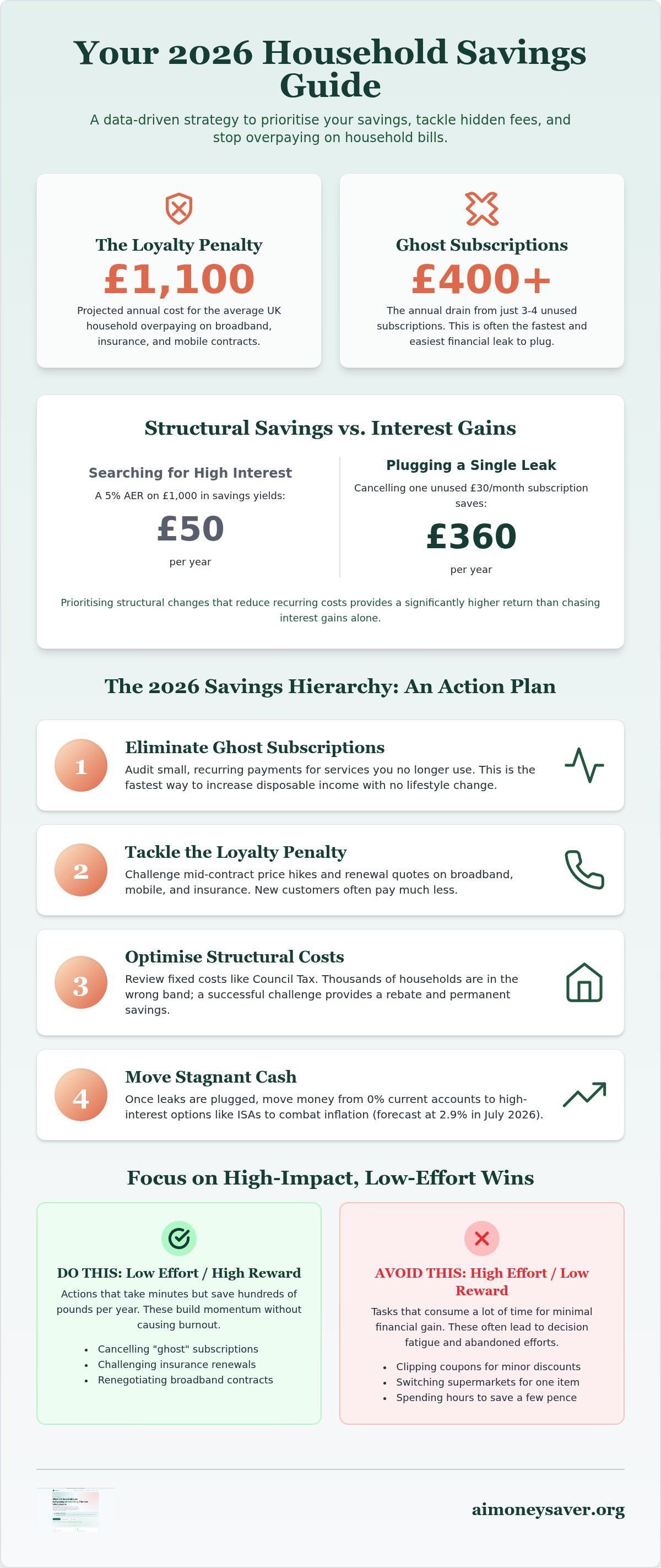
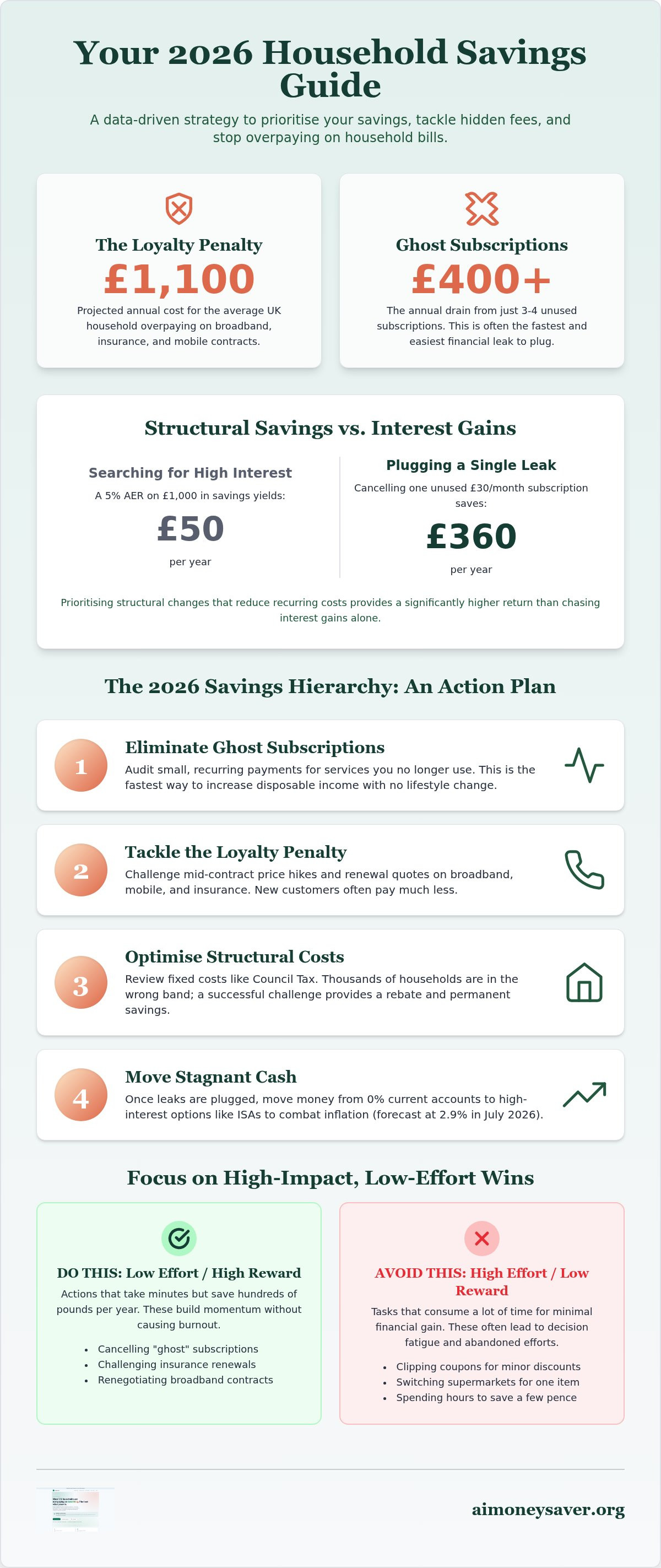
In the 2026 economic climate, with inflation sitting at 2.6% as of June, plugging a "leaky bucket" is more valuable than just searching for high interest. A 5% AER on £1,000 only yields £50 a year. However, identifying a single £30 unused subscription saves you £360 annually. This is the difference between tactical wins, like a one-off refund, and structural wins that reduce your recurring costs. Focus on the structural changes first. This is the foundation of creating a personal budget that provides lasting financial clarity.
The Cost of the UK Loyalty Penalty
Service providers rely on your inertia. They want you to stay quiet whilst they increase your rates. Broadband, insurance, and mobile contracts are the biggest offenders. They often auto-renew at significantly higher prices once your initial deal ends. This is the loyalty penalty. In 2026, the loyalty penalty is projected to cost the average UK household over £1,100 a year in unnecessary overpayments across core services.
The "Effort vs Reward" Matrix
Not all savings require the same amount of work. Some actions are high effort but offer a low reward. Spending an hour to save 50p on a grocery shop is a common mistake. It leads to burnout. You want low-effort, high-reward wins instead. Renegotiating a broadband contract or spotting an overpaid insurance premium takes minutes but can save hundreds of pounds. Your first five ranked savings actions UK should always live in this high-impact quadrant. It builds momentum without the exhaustion of a total life overhaul.
- High Effort/Low Reward: Clipping coupons for minor discounts or switching supermarkets for a single item.
- Low Effort/High Reward: Cancelling "ghost" subscriptions and challenging insurance renewals.
The 2026 Savings Hierarchy: Ranking Actions by Financial Impact
Effective saving is a sequence. You wouldn't try to fill a bathtub without putting the plug in first. The same logic applies to your finances. This hierarchy of ranked savings actions UK ensures you stop the leaks before you try to grow your wealth. It prioritises immediate cash-back over long-term interest gains. Following these ranked savings actions UK prevents you from wasting time on low-impact tasks that don't move the needle.
Rank 1 & 2: The Immediate Cash-Back Phase
Subscriptions are the most common "silent leak" in a UK household budget. They feel small. A £7.99 streaming service or a £4.50 fitness app seems negligible. However, three or four of these "ghost subscriptions" can drain over £400 a year. If you don't use it, kill it. It's the fastest way to increase your disposable income. It requires no lifestyle change, only a digital audit.
Next, tackle the loyalty penalty. Service providers often implement mid-contract price hikes that go unnoticed. If your broadband or mobile bill increased suddenly in April 2026, you're likely paying more than a new customer. Use Quick Savings Scripts to talk to these providers. These scripts provide the exact words to use, removing the stress of negotiation. If you want a clear view of these leaks, our Bank Statement Check can categorise them for you in seconds.
Rank 3 & 4: Structural Optimisation
Once the obvious leaks are plugged, look at structural costs. Council Tax is a prime example. You might be amongst the thousands of people in the UK overpaying because your property is in the wrong band. A successful challenge can result in a significant rebate. It also lowers your monthly outgoings permanently. This is a high-impact, one-time action that provides long-term relief.
Finally, focus on Rank 4: moving stagnant cash. With inflation forecast to rise to 2.9% in July 2026, leaving money in a 0% current account is a guaranteed loss. Only move to this step once Ranks 1-3 are complete. You can find official ISA guidance to help you use your £20,000 annual allowance tax-efficiently. Remember that the FSCS now protects deposits up to £120,000 per person. Minimising outgoings first ensures you have more capital to put into these high-interest accounts.
Manual Audits vs. AI Analysis: Identifying the Hidden Leaks
Most people start a bank statement review with good intentions. They download a PDF. They open a spreadsheet. Ten minutes later, they stop. It's tedious work. Manually scanning hundreds of transactions is prone to error. You miss things. By using a data-driven approach to ranked savings actions UK, you skip the boredom and move straight to the results. You need a method that works as fast as your digital spending does.
AI-driven Bank Statement Checks categorise your spending patterns faster than any manual process. They don't get tired. They don't overlook a £4.99 "ghost" charge hidden amongst grocery bills. This technology turns a mountain of data into a clear, actionable report. It's the difference between guessing your outgoings and knowing them with absolute certainty.
The Pitfalls of Manual Budgeting
Human error is inevitable whilst reviewing three months of transactions. You might overlook a small price increase because it happened gradually. This is "creep". A bill that was £32 last year is now £38. It's subtle enough to ignore but adds up to a significant annual leak. A manual audit often fails to spot these trends over time. We believe a Personal Finance Health Check is better as a quarterly sprint rather than a daily chore. You don't need to track every penny every day. You just need to find the leaks once every few months and plug them.
The Rise of Local AI Spending Analysis
Privacy is a major concern in 2026. Many UK consumers are rightfully nervous about cloud-based budget apps. They don't want their sensitive bank data stored on a third-party server forever. This is the "Privacy Paradox". You want the benefits of AI but fear the data risk. Local processing solves this problem. The analysis happens on your device, ensuring your data never leaves your control. It's a privacy-first way to gain financial clarity.
Speed is the other major advantage. Local AI can analyse 12 months of spending in seconds. It provides a one-off report that is far more useful than a cluttered app dashboard. You don't need another subscription to manage your subscriptions. A one-off ranked savings actions UK audit provides a clear path to follow without the burden of ongoing monitoring fees. It's a pragmatic tool for the everyday consumer who values their time as much as their money.
How to Perform a Personal Finance Health Check in 5 Steps
You don't need a complex 80-row spreadsheet to fix your finances. That feels like homework. Instead, follow a linear path. Start by gathering your bank statements from the last three months. Digital PDFs are easiest, but paper works too. This provides the raw data for your audit. You can't fix what you can't see. It's a simple, necessary starting point for any household audit.
Step 2: The Fixed Cost Audit
Differentiate between essential bills and "convenience" subscriptions. Rent, council tax, and energy are essential. Your third streaming service or a forgotten magazine subscription is a convenience. Check your insurance premiums against what you paid last year. If the price went up without a change in your circumstances, you're paying a loyalty penalty. Look for "zombie" direct debits. A zombie direct debit is a recurring payment for a service you have long forgotten or a product you no longer own. These are the easiest leaks to plug because they provide zero value.
Use a Household Spend Breakdown Tool to visualise where your money goes. Seeing a chart of your spending is often a wake-up call. It highlights patterns you might miss in a long list of transactions. Once you have this clarity, execute your ranked savings actions UK. Start with the items carrying the highest loyalty penalty, such as broadband or car insurance. These offer the biggest return for the least effort. If you want an automated way to see these leaks, get a Personalised Savings Report to do the heavy lifting for you.
Step 5: Maximising the Surplus
Once you've lowered your household expenses, you'll have a surplus. Don't let it sit in a 0% current account. Move this "found" money into a ring-fenced high-interest account immediately. For your first £1,000, choose an "Easy Access" account. This ensures you have liquidity for emergencies. If you have more, consider a "Fixed Rate" bond for a higher yield. Rates in August 2026 for fixed bonds are reaching up to 5.15% AER. Remember, the 2026/2027 ISA allowance is £20,000. This is a tax-efficient destination for your savings. Minimising your outgoings via ranked savings actions UK is only half the battle. The other half is making that extra cash work for you.
Unlocking Clarity: The Ai Money Saver Personalised Savings Report
The theory of ranking is clear. Actually doing it is the hurdle. The Personalised Savings Report removes this friction. It scans your data to generate your bespoke ranked savings actions UK. You receive a clear spend breakdown that separates your essentials from your luxuries. It includes direct comparison links and tailored high-interest recommendations based on current market rates. If your budget is particularly complex, you can opt for a Money Coach Assessment to gain a deeper level of insight. This isn't about vague advice. It's about specific, movement-oriented steps you can take today. You get a digital auditor in your pocket without the high cost of a professional consultant.
Why a One-Off Audit is Enough
Most finance apps want a monthly subscription. They want to watch you spend every day. This constant monitoring often creates more anxiety than it solves. It's another bill you don't need. We follow a "Check-up" philosophy. You don't need an app to tell you that you bought a coffee. You need an auditor to tell you that your broadband is £25 too expensive. A single report creates a roadmap for the next 12 months of savings. It identifies the "Big Three" leaks we discussed earlier: broadband, insurance, and mobile contracts. The £4.99 fee is negligible. It costs less than a single premium sandwich but can identify hundreds of pounds in annual overpayments. It's a pragmatic exchange of value for the everyday consumer who wants results, not another recurring fee.
Privacy and Peace of Mind
Security is our priority. We use local AI processing for our Bank Statement Check. This means your bank data never touches our servers. It stays on your device whilst the analysis happens. You get the power of modern analysis without the risk of a data breach or persistent tracking. We don't store your history. We don't sell your data. There is a profound relief in having a clear, ranked action plan delivered to your inbox. You stop worrying about "what if" and start knowing "what next". The report is direct and honest. It doesn't use high-finance jargon. It just gives you the facts you need to reclaim your budget. It's about clarity, not complexity. You remain in total control of your financial health from start to finish.
Take Control of Your 2026 Household Budget
Financial clarity doesn't require a total lifestyle overhaul. It starts with identifying the silent leaks that drain your bank account every month. By focusing on ranked savings actions UK, you move from feeling overwhelmed to having a clear, prioritised plan. You've learned how to spot "zombie" direct debits and how to challenge the loyalty penalty on your core bills. Now, it's time to execute.
You don't need another monthly subscription to manage your money. Our approach values your time and your privacy above all else. With local device processing, your data stays under your control whilst you get the insights you need. It's a sensible, one-time check-up designed for immediate results. Stop guessing where your money goes and start building a more stable financial future today. There is a profound sense of relief in finally having a roadmap that works. Unlock your Personalised Savings Report now and reclaim your disposable income without the stress.
Frequently Asked Questions
What are the most common overpaid bills in the UK?
Broadband, insurance, and mobile contracts are the top three offenders. Providers often rely on auto-renewals to increase prices without you noticing. Many households also overpay on council tax by being in the wrong band. Checking these items first gives you the best chance of immediate results. It's a simple way to start your ranked savings actions UK audit and find hidden cash quickly.
How does a bank statement analysis help find savings?
It categorises your spending to highlight "ghost" subscriptions and price creep. You might not notice a small monthly increase in a streaming service, but an analysis tool will. It separates your fixed essentials from variable luxuries. This clarity allows you to see exactly where your money goes. It turns a long list of transactions into an actionable roadmap for your household budget and future planning.
Is it safe to upload my bank statement to a savings tool?
Safety depends on how the tool processes your data. Our service uses local AI processing. This means your bank statement never leaves your device. No data is stored on our servers. This privacy-first approach ensures your sensitive information remains secure and private. You get the benefits of advanced data analysis without the risks associated with cloud-based storage or persistent third-party tracking or obligation.
What is the "loyalty penalty" and how do I avoid it?
The loyalty penalty is the extra cost long-term customers pay compared to new ones. Service providers often offer "teaser" rates that expire after 12 or 18 months. You avoid it by switching or renegotiating your contracts as soon as the initial term ends. Use Quick Savings Scripts to help you talk to providers. Being proactive prevents companies from profiting from your inertia and your busy schedule.
How often should I perform a household budget assessment?
A quarterly sprint is usually more effective than a daily chore. Performing a deep dive every three months allows you to spot seasonal trends and catch price hikes early. It keeps your finances lean without becoming a burden on your time. If you do it too often, you get diminishing returns. If you wait a year, you lose too much to overpayments that could have been stopped earlier.
Can I lower my Sky or broadband bill without calling them?
You can often use online chat services or "cancel" buttons to trigger automated retention offers. Many providers have digital portals where you can browse cheaper packages or apply discounts without speaking to a human. However, the best deals usually come from active negotiation. If you prefer to avoid the phone, look for "switch" buttons in your account dashboard to see current available rates and promotional offers today.
What is the difference between a one-off report and a budgeting app?
A one-off report provides a specific roadmap for ranked savings actions UK without ongoing costs. Budgeting apps usually require a monthly subscription and constant data access. Our report is a pragmatic "check-up" rather than a permanent monitoring tool. It gives you the clarity you need to fix your budget once. You don't need a persistent app to watch every single coffee you buy on the high street.
How much can the average UK household save with ranked actions?
Savings vary, but the loyalty penalty alone is projected to cost households over £1,100 in 2026. Identifying unused subscriptions and switching broadband can often reclaim £300 to £500 annually. When you add council tax rebates and better interest rates, the impact is significant. It's about moving from a "leaky bucket" to a solid financial foundation. Every small win adds up to more disposable income for your savings.
Frequently Asked Questions
Broadband, insurance, and mobile contracts are the top three offenders. Providers often rely on auto-renewals to increase prices without you noticing. Many households also overpay on council tax by being in the wrong band. Checking these items first gives you the best chance of immediate results. It's a simple way to start your ranked savings actions UK audit and find hidden cash quickly.
It categorises your spending to highlight "ghost" subscriptions and price creep. You might not notice a small monthly increase in a streaming service, but an analysis tool will. It separates your fixed essentials from variable luxuries. This clarity allows you to see exactly where your money goes. It turns a long list of transactions into an actionable roadmap for your household budget and future planning.
Safety depends on how the tool processes your data. Our service uses local AI processing. This means your bank statement never leaves your device. No data is stored on our servers. This privacy-first approach ensures your sensitive information remains secure and private. You get the benefits of advanced data analysis without the risks associated with cloud-based storage or persistent third-party tracking or obligation.
The loyalty penalty is the extra cost long-term customers pay compared to new ones. Service providers often offer "teaser" rates that expire after 12 or 18 months. You avoid it by switching or renegotiating your contracts as soon as the initial term ends. Use Quick Savings Scripts to help you talk to providers. Being proactive prevents companies from profiting from your inertia and your busy schedule.
A quarterly sprint is usually more effective than a daily chore. Performing a deep dive every three months allows you to spot seasonal trends and catch price hikes early. It keeps your finances lean without becoming a burden on your time. If you do it too often, you get diminishing returns. If you wait a year, you lose too much to overpayments that could have been stopped earlier.
You can often use online chat services or "cancel" buttons to trigger automated retention offers. Many providers have digital portals where you can browse cheaper packages or apply discounts without speaking to a human. However, the best deals usually come from active negotiation. If you prefer to avoid the phone, look for "switch" buttons in your account dashboard to see current available rates and promotional offers today.
A one-off report provides a specific roadmap for ranked savings actions UK without ongoing costs. Budgeting apps usually require a monthly subscription and constant data access. Our report is a pragmatic "check-up" rather than a permanent monitoring tool. It gives you the clarity you need to fix your budget once. You don't need a persistent app to watch every single coffee you buy on the high street.
Savings vary, but the loyalty penalty alone is projected to cost households over £1,100 in 2026. Identifying unused subscriptions and switching broadband can often reclaim £300 to £500 annually. When you add council tax rebates and better interest rates, the impact is significant. It's about moving from a "leaky bucket" to a solid financial foundation. Every small win adds up to more disposable income for your savings.