
UK Household Saving Tips: Ultimate Bill Audit Guide 2026
17 August 2026 · 17 min read
The average UK household currently leaks over £1,000 a year through "invisible" loyalty penalties. You likely feel nickel-and-dimed by small, creeping price hikes on your broadband and insurance. It's frustrating to see new customers get better deals while you're charged more for the same service. You want to fix it. However, the thought of sharing your bank data with another app often feels risky. You need clarity without the compromise.
This guide changes that. By applying these UK household savings tips 2024, you'll learn how to use modern auditing techniques to stop these leaks and reclaim hundreds of pounds from your monthly bills. We'll show you how to identify the hidden costs that providers hope you won't notice. It's about efficiency, not sacrifice. We don't suggest cutting back on things you love. We suggest paying the fair price for them.
We've prepared a ranked list of savings actions to help you find every "invisible" leak in your bank statement. You'll move from feeling squeezed by rising costs to having a clear, actionable plan. If you follow this audit, you'll regain a sense of financial control and keep your data secure. Let's start with the most impactful changes first.
Key Takeaways
- Identify the "loyalty penalty" where providers charge long-term customers more than new ones for the exact same service.
- Target the "Big Four" overpayments in broadband, insurance, energy, and subscriptions using the latest UK household savings tips 2024.
- Discover how modern AI-driven auditing techniques can scan bank statements locally to find hidden leaks without compromising your privacy.
- Access "Quick Savings Scripts" designed to help you confidently renegotiate lower monthly rates with major UK service providers.
- Understand the value of a Personalised Savings Report that provides a clear, ranked list of actions to regain financial control.
Understanding the 'Loyalty Penalty' in UK Household Bills
The loyalty penalty is a quiet drain on your finances. It is the hidden cost of staying with a provider instead of switching. New customers receive the "teaser" rates. Existing customers pay the "standard" tariff. Most UK households miss these hikes because they occur via automated Direct Debits. It feels like a minor fluctuation. It adds up quickly. This behaviour is rampant across broadband, mobile, and insurance. The Financial Conduct Authority (FCA) has clamped down on insurance "price walking," yet other sectors continue to profit from your loyalty. It is a systemic overcharge that rewards new sign-ups while penalising long-term reliability.
Why your 'favourite' brands might be overcharging you
Auto-renewals are built on the hope that you won't check your statement. Brands know that switching feels like a chore. They offer low initial rates to get you through the door. Then, they hike the price once the fixed term ends. If your broadband bill was £25 two years ago, it might be £45 today. You aren't getting a better service. You’re just paying more for the same connection. Staying put is a quiet budget killer. It is a choice to pay more for the sake of five minutes of convenience. Inertia is their biggest profit margin.
Identifying the 'invisible' leaks in your budget
You need to look for the "creep." These are the small, £3 or £5 increases that appear on your bank statements without a clear warning. Across multiple services, these small leaks become a flood. If you have four different contracts that have all rolled onto standard rates, you could be losing over £1,000 a year. Finding these leaks is a core part of effective UK household savings tips 2024. The loyalty penalty is a systemic overcharge where UK consumers lose their right to competitive pricing simply by remaining with a provider beyond their initial contract term.
Identifying these costs is the first step toward recovery. You don't need to be a financial expert to spot them. You just need to know where the providers hide the extra charges. A simple check of your standing orders and Direct Debits is often enough to reveal the truth. By auditing your spending now, you can stop the "loyalty tax" from eroding your household savings. It's your money. There is no reason to let it leak away through simple inattention.
The Anatomy of a Lean Budget: Where Most UK Households Overpay
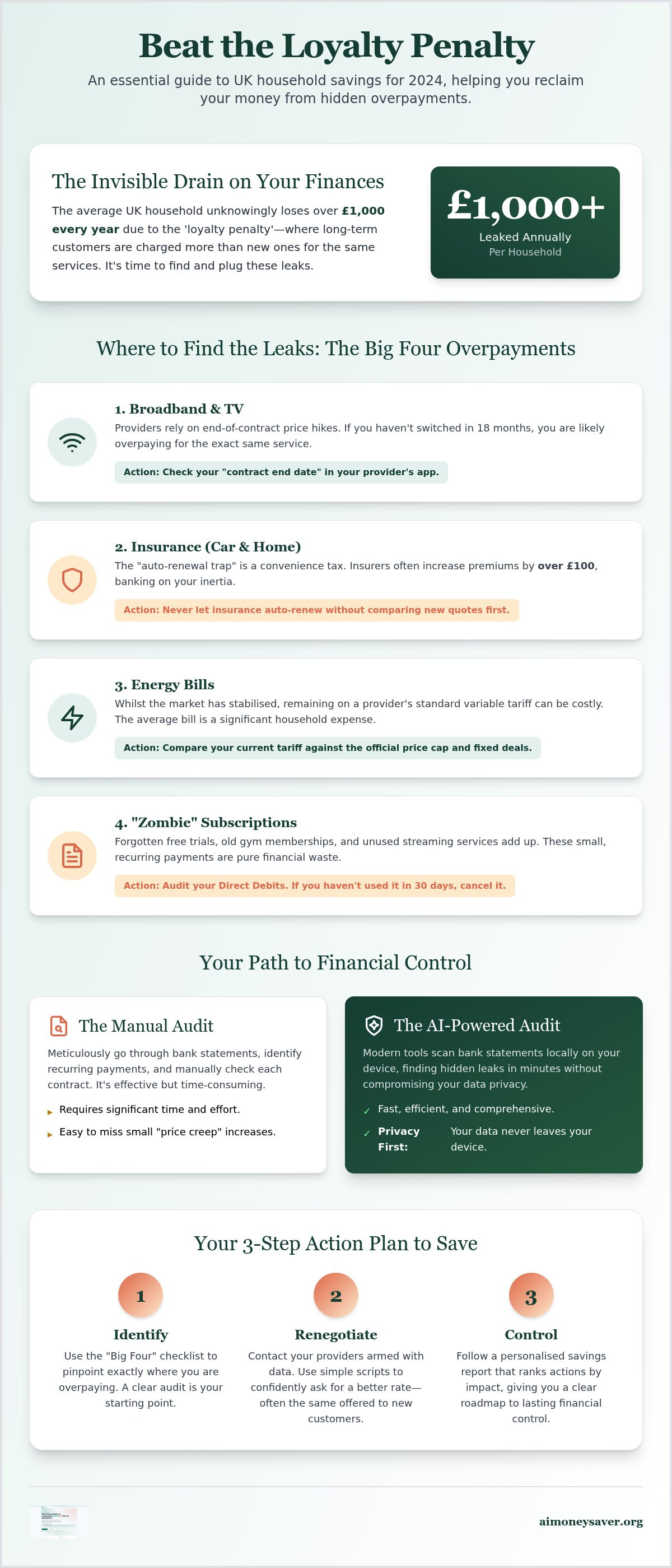
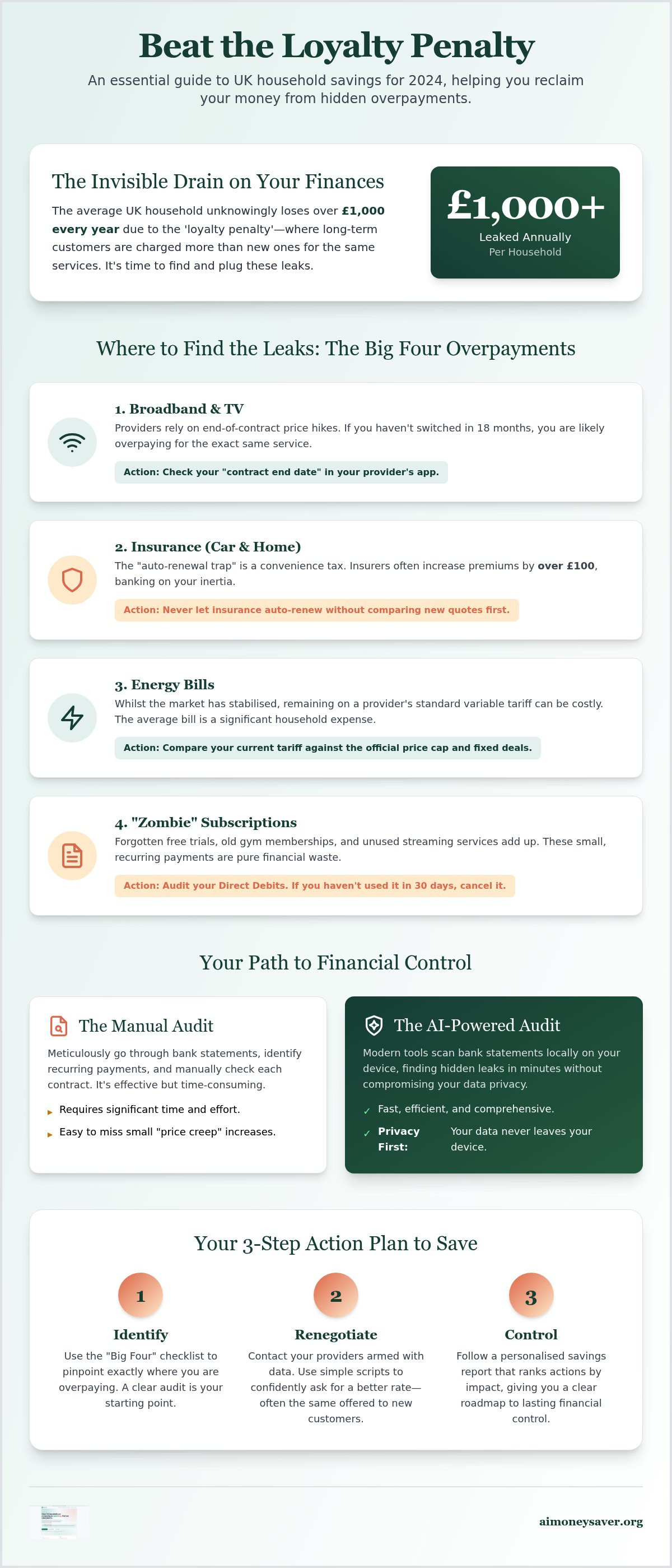
Most households lose money because they don't see the leaks. You might check your balance, but do you check the cost of each line item? Overpayments usually cluster in the "Big Four": broadband, insurance, energy, and subscriptions. Identifying these is the first step in our UK household savings tips 2024. You need a clear household spend breakdown to stop the drain. If you can't see the true picture, you can't fix the problem. This is about clarity. Beyond immediate cuts, you should also review the government's cost of living support to see if you qualify for additional help. Once the data is clear, you can move to Ranked Savings Actions. This means fixing high-impact bills like insurance before worrying about a small streaming hike.
Broadband and TV: The most common overpayment
Are you out of contract? If you haven't switched in 18 months, the answer is likely yes. You can check this by logging into your provider's app. Look for the "contract end date." Don't call them yet. Just find the date. Many people pay for bloated bundles. You might have 500 channels when you only watch five. There is a big difference between essential connectivity and expensive extras. Mid-contract price hikes are annoying, but end-of-contract leaps are where the real damage happens. A quick Bank Statement Check can reveal exactly how much your provider has quietly increased your monthly rate.
Insurance and Utilities: The auto-renewal trap
Never let insurance auto-renew. It is a choice to pay a "convenience tax." Providers often hike car and home insurance by £100 or more if you don't challenge them. In 2026, the average energy bill is around £1,664 per year. Whilst the market has stabilised, "fixing" your rate is only viable if the deal beats the current price cap. You should also hunt for "zombie" subscriptions. These are the gym memberships or niche streaming services you forgot about months ago. They feel small individually. Together, they are a significant budget leak. Check your Direct Debits today. If you haven't used it in 30 days, cancel it. It is that simple.
The 2026 loyalty penalty checklist is straightforward. Check your insurance renewal dates. Find your broadband contract end. Audit your active Direct Debits. By ranking these actions, you focus your energy where the rewards are highest. You don't need to spend hours on every tiny expense. You just need to fix the big leaks first. This pragmatic approach ensures you get the best results for the least effort.
Manual Auditing vs. AI-Driven Spending Analysis
Traditional budgeting is a chore. Most people start with good intentions but stop after a week. The friction of manual tracking is simply too high for a busy household. Digital tools offer a faster path. They turn a long weekend task into a ten-second scan. This speed is essential when searching for UK household savings tips 2024. However, not all digital tools are equal. You must choose between constant surveillance and a focused, one-off audit.
The pros and cons of manual budget planners
Writing down every penny creates mindful spending. It forces you to realise exactly where your money goes. But manual tracking often fails because life gets in the way. If you want to try it, perform a basic Bank Statement Check yourself. Print your statements from the last three months. Use a highlighter to mark every recurring cost. This manual method helps you spot the patterns mentioned in the CMA report on the loyalty penalty. It's a slow process. It's also prone to human error. You might miss a small price hike because it looks like a normal transaction.
Why AI-driven assessments are the modern standard
Modern assessments rely on speed and pattern recognition. AI can categorise a full year of spending in seconds. It identifies the "invisible" leaks that a human eye would likely overlook. Accuracy is the main benefit. Speed is the second. But privacy is the most critical factor for most users. Many budgeting apps upload your data to a central cloud. This creates a permanent digital footprint. Modern AI tools are different. They process your data locally on your own device. Your financial history never leaves your hardware. It's a secure, private way to audit your life without sharing your data with the world.
Choosing a one-off assessment is often more effective than a subscription tracker. You don't need another monthly bill to help you save on bills. A single "financial health check" provides a clear list of Ranked Savings Actions. It gives you the results you need without the constant tracking of your every move. You stay in control. You get the clarity. Then, you can close the tool and move on. It's pragmatic. It's efficient.
Practical Steps to Renegotiate and Reduce Monthly Costs
Negotiation is a skill you can learn. It's about being informed. Most people fail because they don't have a benchmark. Before you pick up the phone, you need to know what a "good" deal looks like. This is a core part of effective UK household savings tips 2024. Preparation is the difference between a £5 saving and a £20 saving. Write down your current monthly cost and the date your contract ended. Having these facts ready makes you sound authoritative. Always aim for the "Retentions" or "Cancellations" department. Frontline staff usually can't offer deep discounts. Their job is to process standard requests. The Retentions team is different. They are measured on how many customers they stop from leaving. They have the authority to drop prices to keep you.
The 'scripts' that actually work
Don't just ask for a discount. State clearly that you're considering leaving. This triggers the retention process immediately. If they offer a "better" package that costs more, stay firm. Tell them: "I'm looking to lower my outgoings, not increase my services." This stops the upsell attempt. If they offer a deal that isn't quite right, don't feel pressured to say yes. You can ask them to put the offer on your notes and call back. This gives you time to verify the deal against the market. Here is a simple script for your broadband provider: "I have seen that a competitor is offering a similar speed for a lower price, and as I'm now out of contract, I'd like to see if you can match it before I start the switching process." It's polite. It's firm. For more specific scenarios, you can download our Quick Savings Scripts.
Knowing your 'walk-away' price
Research is your shield. Spend ten minutes on a comparison site before calling. Find the cheapest price for your current service level. That is your "walk-away" price. If they can't match or beat it, be prepared to leave. Remember that UK consumer law provides a 14-day cooling-off period for most new contracts. This gives you a safety net. Providers often mention your "years of loyalty" to make you feel guilty. Don't fall for it. This is your chance to reverse the loyalty penalty. By being willing to walk away, you force the provider to treat you like a new customer. If they valued your loyalty, they wouldn't have hiked your price in the first place. You are a customer, not a friend. If the deal isn't right, move on.
Securing Your Financial Future with a Personalised Savings Report
Removing the guesswork from your budget is the final step toward financial clarity. You have identified the leaks. You have the scripts to talk to providers. Now you need a plan. A professional-grade financial health check provides this roadmap. It doesn't just categorise your spending. It evaluates it. This is the most effective way to apply UK household savings tips 2024. You stop looking at the past and start fixing the future. It is a transition from being "nickel-and-dimed" to being in total control of every pound that leaves your account.
Moving from 'tracking' to 'actioning'
A list of specific actions is always better than a generic pie chart. Most budgeting apps show you where your money went, but they don't tell you how to get it back. Your report provides Ranked Savings Actions tailored to your specific spend. If you have a free hour on a Saturday, you can use this list to systematically plug the biggest leaks. You focus on the high-impact changes first. If a broadband contract is costing you £20 extra a month, that is your priority. Because this is a one-off assessment, you don't face a recurring subscription fee. You get the value. You take the action. Then you close the file. It is a pragmatic, low-risk tool for the everyday consumer.
Next steps for a robust budget in 2026
Plugging the leaks is only half the battle. You must decide what to do with the recovered cash. With the Bank of England base rate at 3.75% as of August 2026, your savings options are better than they were a few years ago. The cash ISA allowance for the 2026-27 tax year is £20,000. This is a significant opportunity to grow your wealth tax-free. You can find easy-access rates around 5% or even regular savers offering up to 8%. Every pound you claw back from a loyalty penalty is a pound that could be earning interest. You should repeat this household finance review annually. Markets move. Contracts end. A yearly check-up ensures you never pay the "loyalty tax" again.
The path to clarity is linear. Identify the leak. Use the scripts. Secure the savings. You can Get your Personalised Savings Report and stop the leaks today. It is a sensible, one-time check-up that puts you back in the driving seat of your household finances. You don't need to be an expert to have a lean budget. You just need the right data at the right time.
Take Control of Your Monthly Spending
You now have the tools to stop the "loyalty tax" from draining your bank account. Identifying the Big Four overpayments is the first step. Using targeted negotiation scripts is the second. These UK household savings tips 2024 provide a clear path to financial clarity. You don't need to spend hours manually highlighting bank statements to see results. Efficiency is the goal. It's about working smarter, not harder.
A modern audit is the most effective way to secure your financial health. Our AI-driven assessment finds hidden overpayments in minutes. It is 100% private. Your data is processed locally on your own device and never leaves your control. There are no monthly subscriptions or hidden fees. It's a straightforward, one-off check-up for your household budget. You stay in charge of the process from start to finish.
Unlock your Personalised Savings Report and find your hidden cash. You have the strategy. Now you need the data. Take the final step toward a leaner budget today.
Frequently Asked Questions
What is the 'loyalty penalty' and how does it affect UK households?
The loyalty penalty is the extra cost long-term customers pay compared to new sign-ups. Most providers hike rates once your initial contract ends. This affects millions of UK households, especially in the insurance and broadband sectors. It's a quiet budget killer that relies on your inertia. By following UK household savings tips 2024, you can identify these discrepancies and challenge your provider for a fairer rate that matches current market offers.
Is it safe to upload my bank statement to a savings assessment tool?
Safety depends on how the tool processes your information. Many cloud-based apps store your data on external servers, which creates a security risk. Our approach is different because data is processed locally on your own device. Your bank statement never leaves your hardware. This ensures maximum privacy whilst allowing the AI to scan for overpayments. You get the clarity of a professional audit without the vulnerability of a permanent digital footprint.
How much can the average UK household save by auditing their bills?
The average household can save over £1,000 a year by performing a thorough bill audit. This figure comes from identifying overpayments in the "Big Four" categories: broadband, insurance, energy, and subscriptions. For example, renegotiating a car insurance policy can save around £120 annually. These small wins add up quickly. A systematic review of your Direct Debits ensures you aren't paying for "zombie" services you no longer use or value.
What are 'Quick Savings Scripts' and do they really work for broadband?
These are proven templates that help you navigate tough conversations with providers like Sky or Virgin. They work by using specific phrases that trigger a transfer to the "Retentions" department. This team has the authority to offer discounts that frontline staff cannot access. By stating you are considering leaving due to competitor pricing, you force the provider to treat you like a new customer. It's a simple, effective way to lower costs.
Do I need a monthly subscription to track my household budget effectively?
You don't need a monthly subscription to manage your finances. Constant tracking often leads to "friction" and eventual burnout. A one-off assessment is often more practical for busy households. It provides a snapshot of your current leaks and a clear plan to fix them. Once the audit is complete, you can close the tool and focus on your life. This pragmatic approach saves you from adding another recurring bill to your statement.
How can AI help me find overpaid bills that I might have missed?
AI excels at pattern recognition and speed. It can scan 12 months of transactions in seconds to find incremental price hikes that the human eye might miss. Whilst you might overlook a £3 monthly increase, the AI identifies it as a systemic leak. This technology makes applying UK household savings tips 2024 much easier. It categorises your spend accurately and highlights exactly which providers are slowly increasing their margins at your expense.
What is a 'Ranked Savings Action' and why should I follow one?
This is a prioritised list of tasks based on the potential financial impact. Instead of worrying about a small streaming service, you focus on high-value items like insurance or broadband first. Following a ranked list ensures you get the maximum reward for the least effort. It removes the overwhelm of a long "to-do" list. You simply tick off the biggest wins first to regain financial control over a single weekend.
Can I lower my Sky or Virgin bill without losing my favourite channels?
Yes, you can lower these bills without losing your favourite content. Most "bloated" bundles include hundreds of channels you never watch. By identifying your essential viewing habits, you can negotiate a leaner package that retains the channels you love. Providers often offer "loyalty discounts" to stop you from switching to a rival. Be firm about your budget and use competitor rates as leverage to secure a better deal for the same service.
Frequently Asked Questions
The loyalty penalty is the extra cost long-term customers pay compared to new sign-ups. Most providers hike rates once your initial contract ends. This affects millions of UK households, especially in the insurance and broadband sectors. It's a quiet budget killer that relies on your inertia. By following UK household savings tips 2024, you can identify these discrepancies and challenge your provider for a fairer rate that matches current market offers.
Safety depends on how the tool processes your information. Many cloud-based apps store your data on external servers, which creates a security risk. Our approach is different because data is processed locally on your own device. Your bank statement never leaves your hardware. This ensures maximum privacy whilst allowing the AI to scan for overpayments. You get the clarity of a professional audit without the vulnerability of a permanent digital footprint.
The average household can save over £1,000 a year by performing a thorough bill audit. This figure comes from identifying overpayments in the "Big Four" categories: broadband, insurance, energy, and subscriptions. For example, renegotiating a car insurance policy can save around £120 annually. These small wins add up quickly. A systematic review of your Direct Debits ensures you aren't paying for "zombie" services you no longer use or value.
These are proven templates that help you navigate tough conversations with providers like Sky or Virgin. They work by using specific phrases that trigger a transfer to the "Retentions" department. This team has the authority to offer discounts that frontline staff cannot access. By stating you are considering leaving due to competitor pricing, you force the provider to treat you like a new customer. It's a simple, effective way to lower costs.
You don't need a monthly subscription to manage your finances. Constant tracking often leads to "friction" and eventual burnout. A one-off assessment is often more practical for busy households. It provides a snapshot of your current leaks and a clear plan to fix them. Once the audit is complete, you can close the tool and focus on your life. This pragmatic approach saves you from adding another recurring bill to your statement.
AI excels at pattern recognition and speed. It can scan 12 months of transactions in seconds to find incremental price hikes that the human eye might miss. Whilst you might overlook a £3 monthly increase, the AI identifies it as a systemic leak. This technology makes applying UK household savings tips 2024 much easier. It categorises your spend accurately and highlights exactly which providers are slowly increasing their margins at your expense.
This is a prioritised list of tasks based on the potential financial impact. Instead of worrying about a small streaming service, you focus on high-value items like insurance or broadband first. Following a ranked list ensures you get the maximum reward for the least effort. It removes the overwhelm of a long "to-do" list. You simply tick off the biggest wins first to regain financial control over a single weekend.
Yes, you can lower these bills without losing your favourite content. Most "bloated" bundles include hundreds of channels you never watch. By identifying your essential viewing habits, you can negotiate a leaner package that retains the channels you love. Providers often offer "loyalty discounts" to stop you from switching to a rival. Be firm about your budget and use competitor rates as leverage to secure a better deal for the same service.