
One-Time Budget Analysis: The Subscription-Free Way to Audit Your UK Household Spend
18 August 2026 · 16 min read
Why pay a monthly fee just to find out you're paying too many monthly fees? It's a frustrating irony of modern finance. Most budgeting apps want a permanent seat at your table. They ask for your data, your attention, and a recurring subscription just to tell you that you're overspending. A one-time budget analysis offers a cleaner, more pragmatic alternative for the savvy household consumer.
You already know the feeling of being "nickel-and-dimed" by small, unnoticed direct debits. You're likely worried about the "loyalty penalty" on your broadband and insurance too. With the average UK household now spending £3,106 a month on living expenses, even a tiny leak becomes a flood over time. You need clarity, not another commitment. This is about a one-and-done audit that identifies exactly where you're overpaying without the burden of a long-term contract.
In this article, you'll discover how a single financial check-up can uncover hundreds of pounds in hidden savings. We'll show you how to rank your savings actions by impact and audit your bills with total privacy. If you want to stop the "subscription creep" and take back control of your household spend, this is how you start.
Key Takeaways
- Perform a comprehensive audit of your income and expenditure as a single event to avoid the "subscription trap" of modern budgeting apps.
- A one-time budget analysis can identify hundreds of pounds in "vampire" subscriptions and overpaid bills for a fraction of the cost of a monthly service.
- Prioritise your financial security with local AI processing that audits your bank statements without ever storing your sensitive data on external servers.
- Learn how to gather three to six months of digital bank statements to prepare for a professional-grade financial health check.
- Receive a ranked list of savings actions tailored to the UK market, covering everything from broadband to insurance loyalty penalties.
What is a One-Time Budget Analysis and Why Do You Need One?
A one-time budget analysis is a comprehensive audit of your household income against your expenditure, performed as a single, isolated event. Unlike the ongoing chore of creating a personal budget manually, this modern approach uses technology to scan your financial history for immediate patterns. It's a snapshot of your financial health. You get the clarity you need to make changes without the commitment of a new monthly bill.
Traditional budgeting is often a slow process involving spreadsheets and receipts. A modern AI audit is different. It uses local processing to categorise months of data in seconds. It doesn't just track; it evaluates. It looks for "vampire" subscriptions and identifies where you're paying more than the average UK consumer for basic services. This efficiency is why it works as a low-cost, one-off service rather than a persistent subscription.
UK households are facing a renewed cost of living squeeze, with average monthly expenses reaching £3,106 as of mid-2026. This has made 2026 the year of "subscription fatigue." People are tired of recurring fees. Adding a budgeting app to your bank statement often feels like buying a more expensive bucket to catch a leak. A one-off audit provides a "clean slate." It offers the relief of clarity without the weight of another monthly obligation.
The Problem with "Always-On" Budgeting Apps
Many premium budgeting tools in the UK now cost upwards of £120 per year. That's a significant sum just to track your own money. These apps often trigger "notification anxiety" by pinging you for every small coffee purchase or supermarket trip. It's overwhelming and often unnecessary. Most busy professionals don't need a daily play-by-play; they need a high-level strategy. A one-off report is more actionable because it filters out the daily noise and focuses strictly on the big wins.
Who Should Consider a One-Off Financial Audit?
If you haven't switched your broadband or insurance in over 12 months, you're likely paying a "loyalty penalty." This audit is designed for householders who want to stop that leak. It's particularly useful for:
- Families looking to offset rising utility bills and inflation.
- Individuals preparing for a major life change like a mortgage application.
- Retirees who want to ensure their fixed income is working as hard as possible.
If you want to identify exactly which bills are overpaid without the hassle of manual entry, a one-time budget analysis is the pragmatic choice. It respects your time, your data, and your privacy.
Why a Single Audit Beats Monthly Subscription Apps
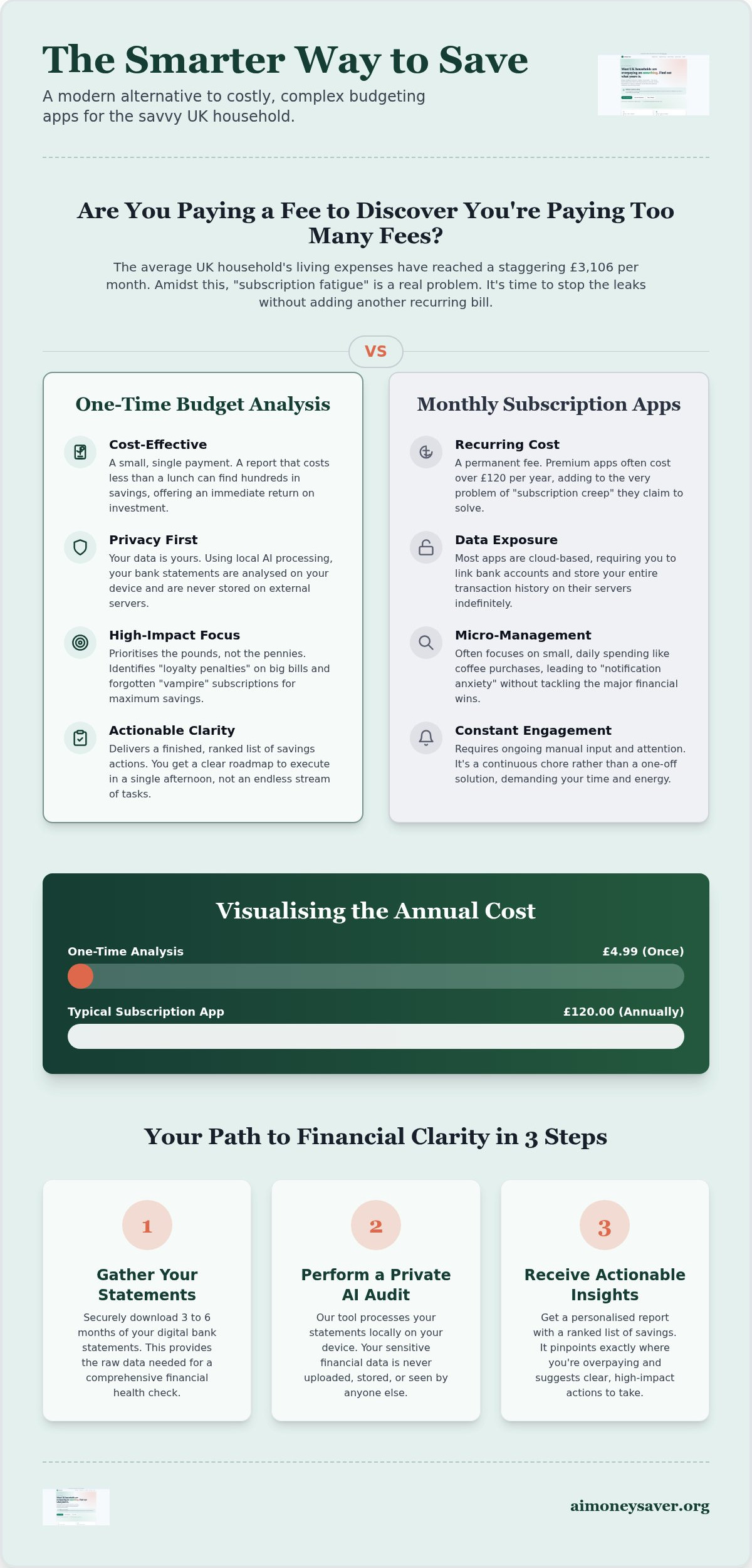
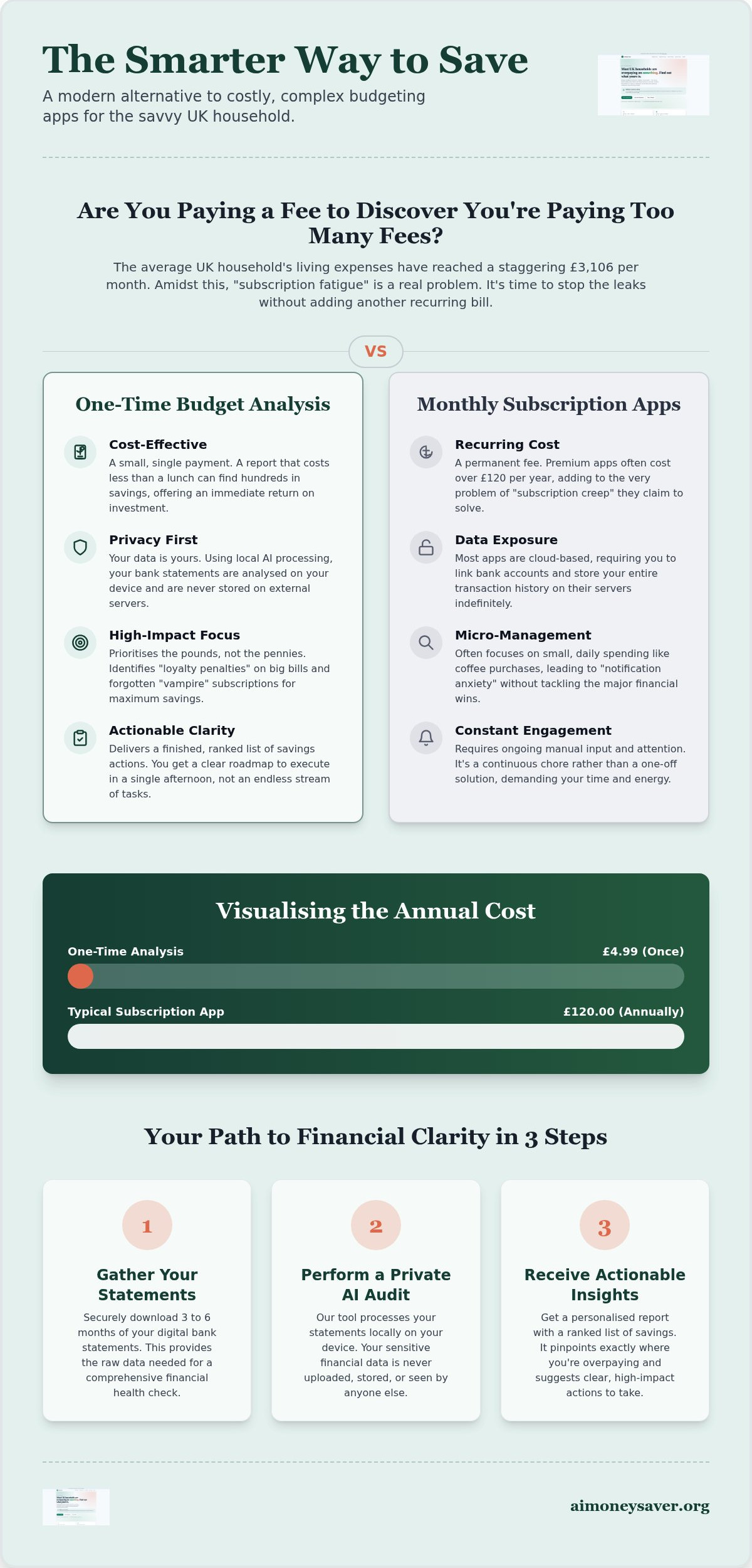
Subscription fatigue is real. Most financial apps want a permanent cut of your income. They promise savings but often cost you £120 a year in premium fees. A one-time budget analysis flips the script. You pay once, get the answers, and move on. It is a finished document, not an endless feed of notifications. Fixing your finances shouldn't require a permanent payroll. This approach gives you the roadmap without the recurring cost.
Apps often focus on the small stuff. They track every latte or supermarket trip. This micro-management creates "notification anxiety" without moving the needle. A single audit looks at the big-ticket items instead. It finds the "loyalty penalty" on your broadband or the insurance policy that hiked its price. These are the wins that actually change your monthly balance. You get a ranked list of actions that you can execute in one afternoon. It prioritises the pounds over the pennies.
The Privacy Advantage of One-Time Tools
Most budgeting apps are cloud-based financial aggregators. They require you to link your bank accounts and store your transaction history on their servers. This creates a persistent digital footprint. A one-off tool is different. By using local AI processing, your bank statements never leave your device. The analysis happens right there. There is no data selling and no long-term storage of your sensitive files. This "no persistence" model is the safest way to handle sensitive financial documents. It ensures your data is processed with direct honesty, especially since the ICO Code of Practice on AI gained statutory footing in May 2026.
Comparing the Long-Term ROI
Let's look at the numbers. A single £4.99 report costs less than a high-street lunch. If it finds just one forgotten £10 subscription or a £20 monthly saving on your car insurance, it has paid for itself four times over in the first month. Unlike a subscription app, the "break-even" point happens almost instantly. You can get a Personalised Savings Report to organise your finances for the entire year in one go. You don't need a year of monitoring to fix a problem that only takes twenty minutes to identify. It is a sensible, low-risk tool for the everyday consumer who values time over constant tracking. A one-time budget analysis provides the relief of clarity without the weight of another monthly obligation.
How a Modern Household Budget Audit Identifies Hidden Leaks
Most people think they know where their money goes. Then they see the data. A one-time budget analysis uses AI to strip away the guesswork. It sorts through hundreds of transactions in seconds. It doesn't just list numbers; it groups them into patterns you can actually understand. This immediate clarity is the first step toward stopping the "subscription creep" that quietly drains UK bank accounts.
We all have them. The gym membership you don't use. The streaming service you forgot about. The new consumer rules introduced in Spring 2026 make it easier to cancel these "vampire" subscriptions, but you still have to find them first. An audit highlights these recurring costs instantly. It ranks them by value, so you can see exactly which forgotten monthly fee is hurting your balance the most.
Detecting Overpaid Bills and Loyalty Penalties
Service providers like Sky or Admiral often rely on you forgetting to renegotiate. If you've been with the same broadband or insurance provider for over 12 months, you're likely paying a premium for your inertia. This is the "loyalty penalty." A modern audit compares your current outgoings against the latest UK market rates. This identifies exactly how much you're overpaying. To help you take action, the process includes "Quick Savings Scripts." These are proven templates you can use to lower your bills without the stress of switching providers. You get the results of a professional negotiation without the awkward phone calls.
Categorising Spend for Maximum Clarity
Clarity comes from structure. We separate your essential "fixed" costs, like mortgages and council tax, from your discretionary "variable" spending. This allows you to apply the 50/30/20 rule to your household income. Ideally, 50% covers needs, 30% goes to wants, and 20% is for savings or debt. Many UK households currently find their "needs" are swallowing 60% or more of their monthly £3,106 average spend. Visualising this cash flow shows you the exact point where your money leaks. Once the leaks are identified, we rank every savings action by ease of implementation and total cash value. You get a clear, prioritised list. You can tackle the biggest wins first and ignore the distractions.
Preparing for Your One-Off Financial Health Check
Preparation isn't about doing the heavy lifting. It's about setting the stage for the technology to work for you. To get the most from a one-time budget analysis, you need to organise your inputs first. Start by downloading your digital bank statements for the last three to six months. Most UK high-street banks offer this as a simple PDF or CSV download within their mobile apps. This timeframe is essential. It captures quarterly utility bills and annual insurance renewals that a single month's view would miss.
Next, prepare a brief list of your most expensive recurring costs. You don't need exact figures yet, but knowing your mortgage, council tax, and energy provider helps the audit identify if you're paying the "loyalty penalty." Finally, set aside 15 minutes of quiet time. This is not a marathon session. It is a focused window to review your personalised findings and decide which of the ranked savings actions you'll execute first. Clarity is the goal here.
Choosing the Right Input Method
You have three main paths depending on your needs. A questionnaire is best if you want a quick, high-level overview without sharing specific transaction data. It's fast and provides a solid starting point. If you want a granular, "no-stone-unturned" audit, a Bank Statement Check is the gold standard. It uses local AI to categorise every single spend with total privacy. For complex situations, such as preparing for retirement or managing multiple income streams, a Money Coach Assessment provides the human perspective that digital tools might miss.
Setting Your Savings Goals
Are you looking to build an emergency fund or just save for a summer holiday? Your goals dictate which savings actions you prioritise. Distinguish between "non-negotiable" expenses, like your water bill, and flexible "lifestyle" choices, like premium coffee or extra streaming services. This clarity helps you prepare for the next step. A one-time budget analysis identifies the surplus cash you didn't know you had. Whether you use it to open a high-interest ISA or simply pay down a credit card, the audit gives you the roadmap to get there. It's about making your money work as hard as you do.
Unlocking Your Personalised Savings Report with Ai Money Saver
Ai Money Saver has become the UK's favourite tool for a one-time budget analysis because it respects the user's time and intelligence. It's built for those who want results without the strings. The pricing is transparent. You pay a single £4.99 fee. There are no hidden catches. There are no recurring bills. It's a negligible cost, roughly the price of a high-street meal deal, but the potential ROI is measured in hundreds of pounds. You get the clarity of a professional audit for the price of a coffee.
Your report provides a clear spend breakdown. It groups your transactions into logical categories that make sense for a UK household. You'll see exactly how your monthly outgoings are distributed across utilities, groceries, and those "vampire" subscriptions. But we don't just show you the data. We provide ranked actions and comparison links to help you execute changes immediately. This is how you stop the quiet leak in your finances. You get a finished document that you can use to negotiate better deals with broadband and energy providers with total confidence.
The Power of Ranked Savings Actions
We tell you exactly which bill to fix first for the biggest impact. Some changes offer a £5 saving; others offer £50. We prioritise the biggest wins for your specific household. You get all your financial "homework" done for you in seconds. The report includes direct comparison links. You can use these to switch to best-rate accounts or renegotiate with your current providers instantly. It turns a complex audit into a simple, actionable checklist. If you have 15 minutes, you have enough time to potentially save hundreds of pounds annually.
A Commitment to UK Privacy and Security
We value your privacy as much as your savings. Our "Local Processing" promise means your bank statements never leave your device. The AI does its work right there on your browser or phone. We don't store your data on our servers. We never sell your personal information to third parties. This is a secure, low-risk tool designed for the modern, security-conscious consumer. You stay in control of your information whilst we provide the insights. It is a pragmatic ally that values your integrity above all else.
Ready to see where your money is really going? It's time to stop the guesswork and start the audit. Get your one-time budget analysis and start saving today. You can see your potential savings for free before you even commit to the report. It's the most sensible way to protect your household spend in 2026.
Take Control of Your Household Spend Today
Clarity shouldn't come with a monthly price tag. You now know how to identify "vampire" subscriptions and escape the loyalty penalties that quietly inflate your UK household bills. A one-time budget analysis is the most pragmatic way to achieve this clarity without the burden of an ongoing contract. It replaces the noise of constant notifications with a single, actionable roadmap for your finances.
Your data security is paramount. Local AI processing ensures your bank statements never leave your device, providing total privacy whilst you audit your spend. You get a ranked list of savings actions that prioritises the biggest wins for your specific situation. It's an efficient, low-risk tool for the everyday consumer who values time over constant tracking.
It's time to stop the guesswork. You can organise your finances for the entire year in less time than it takes to eat lunch. Unlock your personalised savings report for a one-off £4.99 fee and start your journey to a cleaner financial slate. You've done the preparation; now it's time to see the results. Taking the first step towards a healthier budget has never been more straightforward.
Frequently Asked Questions
Is a one-time budget analysis better than using a free budgeting app?
A one-time budget analysis is often superior because it avoids the data-sharing trade-offs of "free" tools. Many free apps track your behaviour to sell insights to third parties. This audit provides a professional-grade report without the "notification anxiety" of daily tracking. You get a clear, finished document that identifies big-ticket savings instantly. It is a pragmatic choice for those who value privacy and a clean financial slate over constant monitoring.
How much does a personalised savings report cost in the UK?
The report costs a single, one-off fee of £4.99. This price is transparent and covers the full AI audit of your household spend. There are no hidden catches or recurring charges. When you consider the average UK household spends £3,106 per month, this small investment is negligible. It often pays for itself by identifying just one forgotten subscription or an overpaid insurance premium in your first month of implementation.
Will uploading my bank statement to an AI tool affect my credit score?
No, performing a budget audit has absolutely no impact on your credit score. This process is not a credit application and does not involve a "hard" or "soft" search of your credit file. You are simply reviewing your own historical transaction data to find savings. It is a private, internal check-up that helps you manage your money more effectively without alerting lenders or affecting your ability to borrow in the future.
Can a one-time budget analysis help me find overpaid utility bills?
Yes, the analysis specifically targets recurring costs like energy, broadband, and water. By scanning three to six months of data, the AI identifies patterns and compares your current rates against the best available UK market offers. If you've stayed with the same provider for over 12 months, you're likely overpaying. The report highlights these discrepancies and provides ranked actions to help you lower your monthly outgoings without the stress of switching.
Do I need to sign up for a subscription to use Ai Money Saver?
You don't need to sign up for any recurring subscription. The service is designed to be a "one-and-done" solution for busy households. You pay for the report you need, receive your findings, and that is it. This model respects your desire to avoid "subscription creep" whilst providing immediate value. It is a straightforward tool for those who want a professional financial health check without adding another monthly bill to their bank statement.
How long does it take to receive a household budget assessment?
The assessment is delivered almost instantly once your data is processed. Because the tool uses local AI technology, it can categorise hundreds of transactions in seconds. You don't have to wait days for a manual review or a human auditor to get back to you. After setting aside about 15 minutes to gather your statements and review the findings, you'll have a complete, ranked list of savings actions ready to implement.
Is my financial data safe during a one-off AI audit?
Your data is exceptionally safe because of our "local processing" model. Your bank statements never leave your device and are never stored on external servers. This approach ensures total privacy and complies with the latest UK data standards, including the ICO Code of Practice on AI. We don't sell your data to third parties or maintain a persistent digital footprint of your finances. It is a secure, private way to audit your household spend.
What is the "loyalty penalty" and can a budget analysis help me avoid it?
The "loyalty penalty" is the extra cost you pay when a provider automatically renews your contract at a higher rate. It is common with broadband, mobile, and insurance providers in the UK. A one-time budget analysis identifies these price hikes by spotting where your premiums have increased over time. The report provides "Quick Savings Scripts" to help you challenge these costs. It gives you the evidence you need to renegotiate a better deal with confidence.
Frequently Asked Questions
If you haven't switched your broadband or insurance in over 12 months, you're likely paying a "loyalty penalty." This audit is designed for householders who want to stop that leak. It's particularly useful for: If you want to identify exactly which bills are overpaid without the hassle of manual entry, a one-time budget analysis is the pragmatic choice. It respects your time, your data, and your privacy. Subscription fatigue is real. Most financial apps want a permanent cut of your income. They promise savings but often cost you £120 a year in premium fees. A one-time budget analysis flips the script. You pay once, get the answers, and move on. It is a finished document, not an endless feed of notifications. Fixing your finances shouldn't require a permanent payroll. This approach gives you the roadmap without the recurring cost. Apps often focus on the small stuff. They track every latte or supermarket trip. This micro-management creates "notification anxiety" without moving the needle. A single audit looks at the big-ticket items instead. It finds the "loyalty penalty" on your broadband or the insurance policy that hiked its price. These are the wins that actually change your monthly balance. You get a ranked list of actions that you can execute in one afternoon. It prioritises the pounds over the pennies.
A one-time budget analysis is often superior because it avoids the data-sharing trade-offs of "free" tools. Many free apps track your behaviour to sell insights to third parties. This audit provides a professional-grade report without the "notification anxiety" of daily tracking. You get a clear, finished document that identifies big-ticket savings instantly. It is a pragmatic choice for those who value privacy and a clean financial slate over constant monitoring.
The report costs a single, one-off fee of £4.99. This price is transparent and covers the full AI audit of your household spend. There are no hidden catches or recurring charges. When you consider the average UK household spends £3,106 per month, this small investment is negligible. It often pays for itself by identifying just one forgotten subscription or an overpaid insurance premium in your first month of implementation.
No, performing a budget audit has absolutely no impact on your credit score. This process is not a credit application and does not involve a "hard" or "soft" search of your credit file. You are simply reviewing your own historical transaction data to find savings. It is a private, internal check-up that helps you manage your money more effectively without alerting lenders or affecting your ability to borrow in the future.
Yes, the analysis specifically targets recurring costs like energy, broadband, and water. By scanning three to six months of data, the AI identifies patterns and compares your current rates against the best available UK market offers. If you've stayed with the same provider for over 12 months, you're likely overpaying. The report highlights these discrepancies and provides ranked actions to help you lower your monthly outgoings without the stress of switching.
You don't need to sign up for any recurring subscription. The service is designed to be a "one-and-done" solution for busy households. You pay for the report you need, receive your findings, and that is it. This model respects your desire to avoid "subscription creep" whilst providing immediate value. It is a straightforward tool for those who want a professional financial health check without adding another monthly bill to their bank statement.
The assessment is delivered almost instantly once your data is processed. Because the tool uses local AI technology, it can categorise hundreds of transactions in seconds. You don't have to wait days for a manual review or a human auditor to get back to you. After setting aside about 15 minutes to gather your statements and review the findings, you'll have a complete, ranked list of savings actions ready to implement.
Your data is exceptionally safe because of our "local processing" model. Your bank statements never leave your device and are never stored on external servers. This approach ensures total privacy and complies with the latest UK data standards, including the ICO Code of Practice on AI. We don't sell your data to third parties or maintain a persistent digital footprint of your finances. It is a secure, private way to audit your household spend.
The "loyalty penalty" is the extra cost you pay when a provider automatically renews your contract at a higher rate. It is common with broadband, mobile, and insurance providers in the UK. A one-time budget analysis identifies these price hikes by spotting where your premiums have increased over time. The report provides "Quick Savings Scripts" to help you challenge these costs. It gives you the evidence you need to renegotiate a better deal with confidence.