Personal Finance Health Check UK: The 2026 Independent Audit Guide
16 August 2026 · 16 min read
What if your loyalty to your broadband provider or car insurer is actually a hidden tax you've volunteered to pay? It's a frustrating reality for many households. With the average credit card APR sitting at a staggering 35.8% in 2026, every pound lost to an expired contract is a pound that isn't working for you. Performing a personal finance health check UK shouldn't mean handing your data to a bank that just wants to sell you a loan. It should be a private, clinical look at where your money goes.
You probably feel overwhelmed by endless bank statements and the fear of your data being sold by financial apps. It's exhausting to keep track of every price hike whilst inflation sits at 2.6%. This guide promises a different approach. You'll learn how to run an independent audit that stays on your device, identifying the exact loyalty penalties draining your accounts. We'll provide a ranked list of savings actions to ensure your budget is robust for the year ahead. From managing your £20,000 ISA allowance to using scripts that lower your bills, you'll gain total clarity without the sales pitch.
Key Takeaways
- Conduct a personal finance health check UK to uncover hidden "loyalty penalties" that often cost households hundreds of pounds on insurance and broadband renewals.
- Stop relying on bank-led tools that prioritise selling you new credit products over protecting your privacy and data.
- Learn the 30-minute DIY sequence to audit your bank statements and identify recurring leaks without needing complex spreadsheets or finance jargon.
- Discover how to use Quick Savings Scripts to negotiate better rates with providers whilst keeping your personal information stored safely on your own device.
- Shift from a passive budget to an active strategy by generating a ranked list of savings actions tailored to your specific 2026 spending habits.
What is a Personal Finance Health Check in the UK?
A personal finance health check UK is a structured, systematic review of your financial life. It isn't about complex wealth management or picking stocks. Instead, it focuses on the mechanics of your household economy: your budget, your savings, and your recurring outgoings. The goal is simple. You want to know exactly where every pound goes amongst your various providers. By looking at what is a personal budget through the lens of an auditor, you can spot inefficiencies that a casual glance at a bank app will miss. This is a tool for household efficiency. It is important to clarify that this is not regulated financial advice; it is a practical audit designed to keep your money in your pocket.
The difference between a bank check and an independent audit
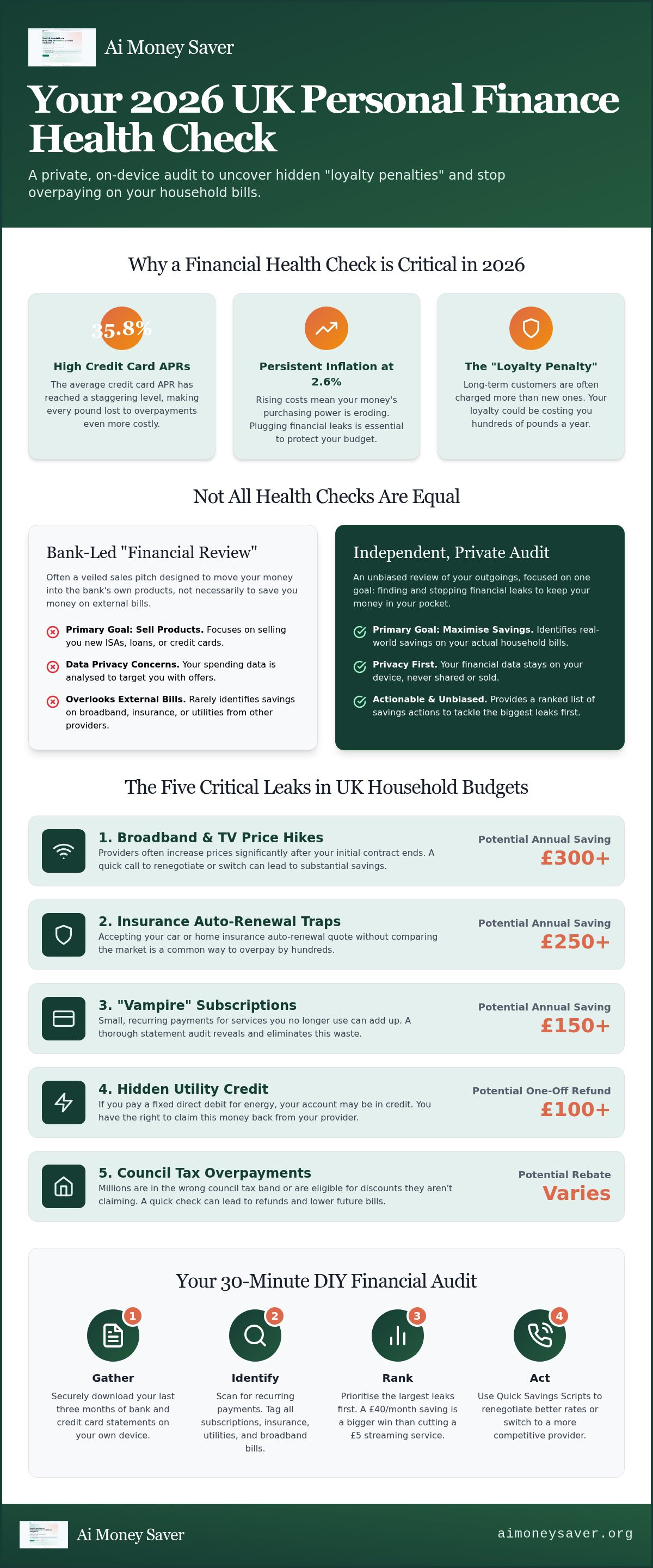
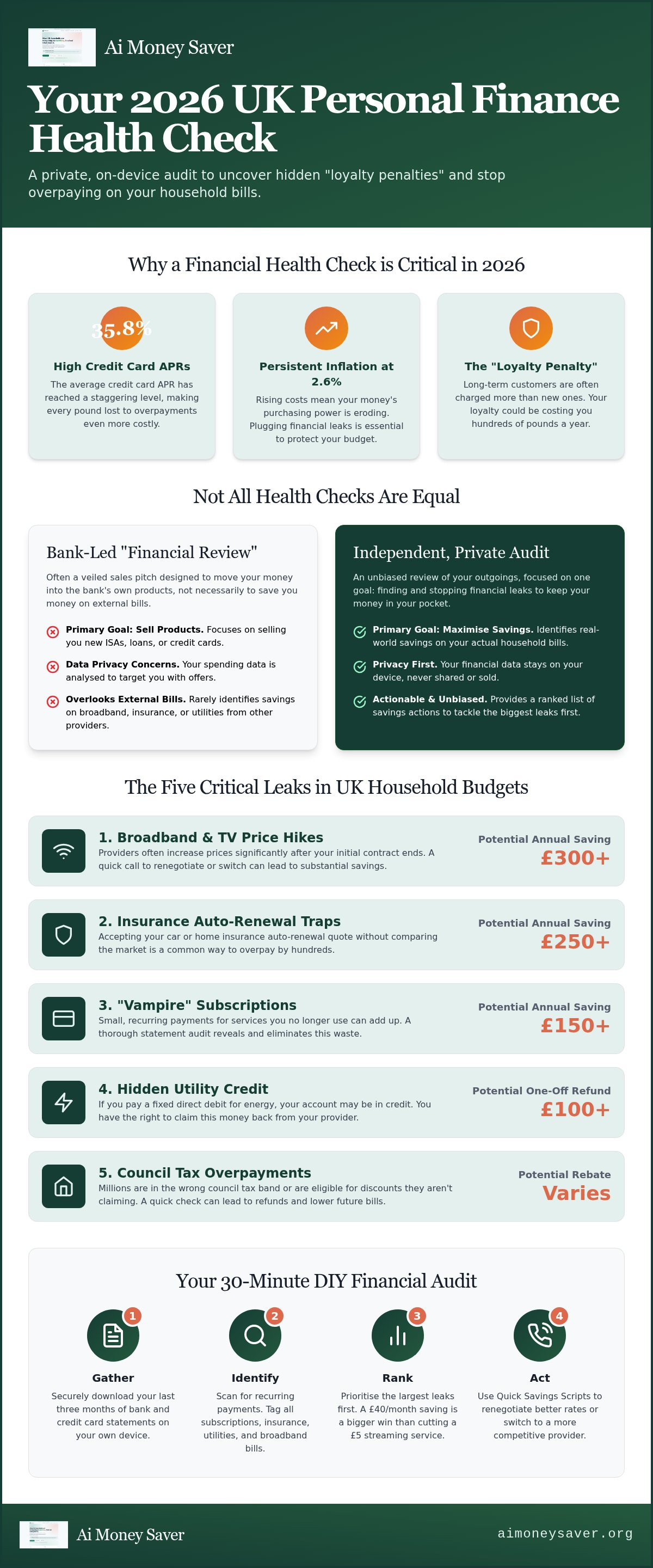
Many high-street banks offer "fitness scores" or "financial reviews". However, these often have a specific motive. Banks focus on selling you their own ecosystem, such as new ISAs, loans, or credit cards. Their tools are designed to move your money into their products. An independent audit is different. It looks outward at your bills: broadband, car insurance, and home utilities. Independence matters because it allows for a cold, unbiased look at market rates. Whilst a bank might suggest you "invest" more, an independent check might show you're overpaying by £300 a year on a legacy insurance policy. One is a sales pitch; the other is a recovery mission.
Why 2026 requires a more robust approach
In 2026, the financial landscape has shifted. With inflation at 2.6% and the Bank of England base rate at 3.75%, the cost of "doing nothing" has increased. UK bank statements are now cluttered with "vampire" subscriptions; small, recurring payments that often go unnoticed until they've drained hundreds of pounds. Manual spreadsheets are no longer enough to track these nuances. We are seeing a shift towards privacy-first AI analysis. This technology can spot patterns and price-hikes faster than any human. A personal finance health check UK must now include a specific audit of the "loyalty penalty". This is the extra cost providers charge long-term customers who don't switch. In a year where every penny counts, identifying these leaks is the difference between a robust budget and a failing one.
The Five Critical Leaks in UK Household Budgets
Identifying where money vanishes is the core of a personal finance health check UK. Most households overpay by hundreds of pounds annually. This isn't usually due to large, one-off purchases. It's the "loyalty penalty". This is a quiet tax on people who don't switch providers. Being a long-term customer often costs you more than being a new one. Providers bank on your inertia. They assume you won't notice a small monthly increase, but these increments add up to a significant drain on your household economy.
Recent UK household spending data highlights that housing and essential services dominate our outgoings. Within these figures, service contracts hide the largest inefficiencies. Wasteful spending often stems from subscriptions you forgot to cancel whilst life got busy. You need to rank your savings actions. Fixing the biggest leaks first ensures maximum impact with minimum effort. A £40 saving on a broadband bill is worth more than cutting a £5 streaming service.
Broadband and TV: The hidden price-hike
Scan your bank statement for sudden price increases. These usually signal the end of an introductory contract. Bundled packages from major UK providers offer convenience, but that ease comes at a high price. You can often save £20 to £30 a month just by asking for a better deal. Using specific scripts to renegotiate with providers like Sky or Virgin can yield immediate results. If they won't budge, being prepared to switch is your strongest leverage. Don't pay for "convenience" that costs you £300 a year.
Insurance and Utilities: Auto-renewal traps
Auto-renewal is the enemy of a robust budget. It's a trap designed to keep you on uncompetitive rates without you noticing. Car and home insurance premiums fluctuate wildly year to year. If you don't check the current market against your renewal quote, you're likely overpaying. Also, look for "hidden" assets like utility credit balances or overpaid council tax. These are common leaks that return cash directly to your pocket. If you haven't checked your energy account balance lately, you might be owed a significant refund. Getting a clear view of these leaks is easier with a Personalised Savings Report, which can rank these actions based on your actual spending.
Why Bank-Led Health Checks Often Miss the Mark
Most UK banks now offer some form of digital "financial review" or "fitness score". It's often free and built directly into your banking app. However, "free" usually comes with a hidden cost. Banks are businesses. They are incentivised to keep your capital and your debt within their own ecosystem. If you use their tools, the results often point toward their own products. You might be told to open a new ISA or take out a personal loan. They rarely suggest you switch to a cheaper broadband provider or audit your insurance premiums. This is the fundamental flaw in a bank-led personal finance health check UK. It is a sales funnel disguised as a service.
There is also the friction of appointments. Traditional banks often require you to book a phone call or visit a branch for a "comprehensive" review. For time-poor households, this is a significant barrier. Most people don't want to spend 45 minutes in a branch discussing their spending habits with a stranger. An independent audit removes this pressure. It allows you to review your outgoings on your own terms, without the feeling that you're being "managed" by a corporate entity. Independence ensures that the focus remains on your savings, not the bank’s profit margins.
Privacy and data security in 2026
In 2026, data is the most valuable currency. Many "free" budget trackers operate on a cloud-based model. They store your bank statements and spending patterns on their company servers. This creates a permanent digital footprint that can be used for targeted adverts or sold to third parties. You should never store your sensitive bank statements on a company server if you can avoid it. True privacy requires a different technical approach. Ai Money Saver processes data locally on your phone or laptop. This means your financial details never leave your device. You get the clarity of a professional audit without the risk of a data breach or persistent tracking.
The "One-Off" advantage
Subscription fatigue is a real problem for UK households. We are already managing dozens of recurring payments for everything from streaming to software. Adding another monthly fee for "financial monitoring" often feels counterproductive. This is why a one-off report is often more effective than a persistent banking app. There is a psychological relief in a one-time fee. It provides immediate clarity without an ongoing commitment. A single £4.99 report can identify overpayments that total £499 or more across a single year. You pay for the insight, fix the leaks, and move on. It is a clean, efficient transaction that respects both your time and your wallet.
Your 30-Minute DIY Financial Health Checklist
You don't need a day at the office to fix your finances. A 30-minute personal finance health check UK can be done this weekend from your sofa. Start by gathering your documents. You'll need your last three months of bank statements, insurance renewal notices, and your latest utility bills. We use the "Three-Month Rule" because trends matter more than snapshots. A single month might have an unusual expense; three months reveal the true patterns of your spending behaviour. Once you have your data, you can categorise, compare, and then take action.
Step 1: The Bank Statement Audit
Open your statements and look for the recurring leaks. Highlight every direct debit and standing order. If you find a service you haven't used in 30 days, it's a "zombie" subscription. Cancel it immediately. This is a quick win that adds up over a year. Next, check the start dates on your broadband and mobile contracts. If you've been with the same provider for over 18 months, you're likely paying a loyalty penalty. Providers often increase rates once the initial term ends. Identifying these dates allows you to see exactly when your "introductory" price became a "convenience" tax.
- Zombie Subscriptions: Gym memberships, streaming apps, or magazine trials you forgot to end.
- Contract End Dates: Mark these in your calendar 30 days before they expire.
- Direct Debit Drift: Check if your energy or water bills have quietly increased without notice.
Step 2: The Comparison Phase
Now, benchmark your money against the current market. Look at your savings first. With the Bank of England base rate at 3.75%, your cash should be earning at least 4% to 5% in an easy-access account. If it's sitting in a current account paying 0.1%, you're losing value whilst inflation sits at 2.6%. Ensure you're utilising your £20,000 ISA allowance effectively. For your bills, use comparison tools to find the current market average for car and home insurance. If your renewal quote is higher, you have leverage. Draft a short negotiation script: state the market rate, mention your loyalty, and ask them to match it. A five-minute call can often save you £150 a year.
If you want a faster, automated way to rank these actions, you can run a Bank Statement Check to get a clear list of savings priorities in minutes.
Optimising Your Finances with an AI-Driven Audit
A manual personal finance health check UK is an excellent starting point. However, manual audits are often limited by human error and the time it takes to cross-reference every transaction. AI analysis provides a level of precision that a standard spreadsheet simply cannot match. It scans for recurring patterns, identifies subtle price-creep, and compares your outgoings against current market benchmarks in seconds. This speed allows you to transition from a passive "health check" to an active "savings action plan" without the need for hours of research or complex calculations.
Traditional banks often suggest webinars or appointments with specialists to review your spending. These methods are slow and often lead to a product pitch. AI-driven tools remove this friction. They provide an objective look at your household economy, focusing on where you can save rather than where you can borrow. By using technology that works for you, not the bank, you gain a transparent view of your financial efficiency.
How the Personalised Savings Report works
The system is designed to be low-friction and highly secure. You have three distinct ways to generate your audit. The first is a quick questionnaire. This is ideal for a high-level overview of your household spending and general habits. The second option is the Bank Statement Check. This is a deep-dive audit where you upload your digital statements. The AI processes this data locally on your device, ensuring your sensitive information never leaves your phone or laptop. Finally, you can opt for a Money Coach Assessment. This provides a tailored review for those who prefer a human perspective alongside the data-driven insights.
Executing your savings actions
Clarity only has value if it leads to action. Once your report is generated, it provides a list of ranked savings actions. This tells you exactly which leak to plug first to get the best return on your time. You don't have to guess what to say to your providers. You can use Quick Savings Scripts to contact your broadband or insurance companies today. These scripts are pre-written to help you negotiate better rates with confidence. The report also highlights if your cash is sitting in accounts that pay less than the current market rates. Moving your money to the best-rate accounts or ISAs recommended in your audit ensures your savings are working as hard as possible.
Unlock your Personalised Savings Report for £4.99 today at aimoneysaver.org
Secure Your Household Budget for 2026
Clarity is the first step toward true financial efficiency. You've now seen how simple it is to identify loyalty penalties and "zombie" subscriptions with a structured audit. By moving away from bank-led sales tools, you regain control over your outgoings without being pushed into new loans or unnecessary products. A personal finance health check UK is a sensible, one-time task that protects your money from the quiet creep of contract price-hikes.
Privacy is central to this process. Your financial data is processed locally on your device for total security. There are no monthly subscriptions; you simply get a one-off report with ranked savings actions and the negotiation scripts you need to lower your bills. It's a low-risk way to ensure your household budget is as robust as possible for the year ahead.
Ready to plug the leaks in your spending? Get your Personalised Savings Report for a one-off £4.99 and start your audit today. Taking charge of your finances is a practical step that provides immediate relief and long-term clarity.
Frequently Asked Questions
How often should I do a personal finance health check in the UK?
You should perform a personal finance health check UK at least once a year. Ideally, do this 30 days before your largest annual renewals, such as car or home insurance. This frequency ensures you catch price-hikes before they auto-renew. If you experience a major life change, like a salary increase or moving house, an immediate audit is sensible. Regular checks prevent loyalty penalties from accumulating over several years.
Is a financial health check the same as regulated financial advice?
No, a budget audit is not regulated financial advice. It is a systematic review of your outgoings and efficiency. Regulated advice involves specific recommendations on investments, pensions, or mortgages from a qualified professional. A health check focuses on your household spending, utility bills, and service contracts. It identifies where you are overpaying for existing services rather than telling you where to invest your capital for future growth.
Can I do a health check if I am currently in debt?
Yes, conducting a check is essential if you are in debt. Identifying hidden leaks in your budget can free up cash to accelerate your repayments. When credit card APRs are as high as 35.8% in 2026, every pound saved on a broadband bill is a pound that can reduce high-interest debt. An audit provides the clarity needed to prioritise your outgoings and find the most efficient path to becoming debt-free.
What documents do I need for a UK household budget audit?
You need three months of bank statements to identify recurring spending patterns. Gather your latest insurance renewal notices, broadband contracts, and utility bills. These documents contain your contract end dates and current pricing. Having these to hand allows for a precise comparison against current market rates. If you use a digital Bank Statement Check, you can simply download your statements as PDF files from your banking app for local processing.
How do I identify a loyalty penalty on my monthly bills?
Look at your bill and find the contract start date. If your initial 12 or 18-month term has ended, your price has likely jumped to a standard rate. Compare this monthly cost against the price offered to new customers on the provider's website. The difference between these two figures is your loyalty penalty. Identifying this gap gives you the leverage needed to negotiate a better deal using specific Quick Savings Scripts.
Is it safe to upload my bank statements to budget audit tools?
Safety depends entirely on the technology used. Many cloud-based apps store your data on their servers, which carries a risk of breaches or tracking. However, it is safe if the tool uses local-device processing. This means your bank statements are analysed on your own phone or laptop and never uploaded to a company server. Always check for a privacy-first guarantee that promises your sensitive financial data is never stored.
What is the difference between a bank health check and an independent one?
Banks use health checks to keep your money within their own products, such as loans or ISAs. They rarely look at your external bills. An independent personal finance health check UK focuses on your outgoings across all providers. It audits your broadband, insurance, and utilities to find the best market rates. Independence ensures the results are unbiased and focused on reducing your household costs rather than increasing the bank's profit margins.
How much can a typical UK household save after a health check?
Savings vary, but many UK households find they are overpaying by several hundred pounds a year. The largest gains usually come from insurance renewals and broadband contracts. For example, switching a legacy broadband deal or renegotiating a car insurance premium can save £150 to £300 annually. When combined with cancelling forgotten subscriptions, the total savings often far exceed the £4.99 cost of a professional Personalised Savings Report.
Frequently Asked Questions
You should perform a personal finance health check UK at least once a year. Ideally, do this 30 days before your largest annual renewals, such as car or home insurance. This frequency ensures you catch price-hikes before they auto-renew. If you experience a major life change, like a salary increase or moving house, an immediate audit is sensible. Regular checks prevent loyalty penalties from accumulating over several years.
No, a budget audit is not regulated financial advice. It is a systematic review of your outgoings and efficiency. Regulated advice involves specific recommendations on investments, pensions, or mortgages from a qualified professional. A health check focuses on your household spending, utility bills, and service contracts. It identifies where you are overpaying for existing services rather than telling you where to invest your capital for future growth.
Yes, conducting a check is essential if you are in debt. Identifying hidden leaks in your budget can free up cash to accelerate your repayments. When credit card APRs are as high as 35.8% in 2026, every pound saved on a broadband bill is a pound that can reduce high-interest debt. An audit provides the clarity needed to prioritise your outgoings and find the most efficient path to becoming debt-free.
You need three months of bank statements to identify recurring spending patterns. Gather your latest insurance renewal notices, broadband contracts, and utility bills. These documents contain your contract end dates and current pricing. Having these to hand allows for a precise comparison against current market rates. If you use a digital Bank Statement Check, you can simply download your statements as PDF files from your banking app for local processing.
Look at your bill and find the contract start date. If your initial 12 or 18-month term has ended, your price has likely jumped to a standard rate. Compare this monthly cost against the price offered to new customers on the provider's website. The difference between these two figures is your loyalty penalty. Identifying this gap gives you the leverage needed to negotiate a better deal using specific Quick Savings Scripts.
Safety depends entirely on the technology used. Many cloud-based apps store your data on their servers, which carries a risk of breaches or tracking. However, it is safe if the tool uses local-device processing. This means your bank statements are analysed on your own phone or laptop and never uploaded to a company server. Always check for a privacy-first guarantee that promises your sensitive financial data is never stored.
Banks use health checks to keep your money within their own products, such as loans or ISAs. They rarely look at your external bills. An independent personal finance health check UK focuses on your outgoings across all providers. It audits your broadband, insurance, and utilities to find the best market rates. Independence ensures the results are unbiased and focused on reducing your household costs rather than increasing the bank's profit margins.
Savings vary, but many UK households find they are overpaying by several hundred pounds a year. The largest gains usually come from insurance renewals and broadband contracts. For example, switching a legacy broadband deal or renegotiating a car insurance premium can save £150 to £300 annually. When combined with cancelling forgotten subscriptions, the total savings often far exceed the £4.99 cost of a professional Personalised Savings Report.