
Personal Savings Report UK: How to Audit Your Household Spend in 2026
16 August 2026 · 16 min read
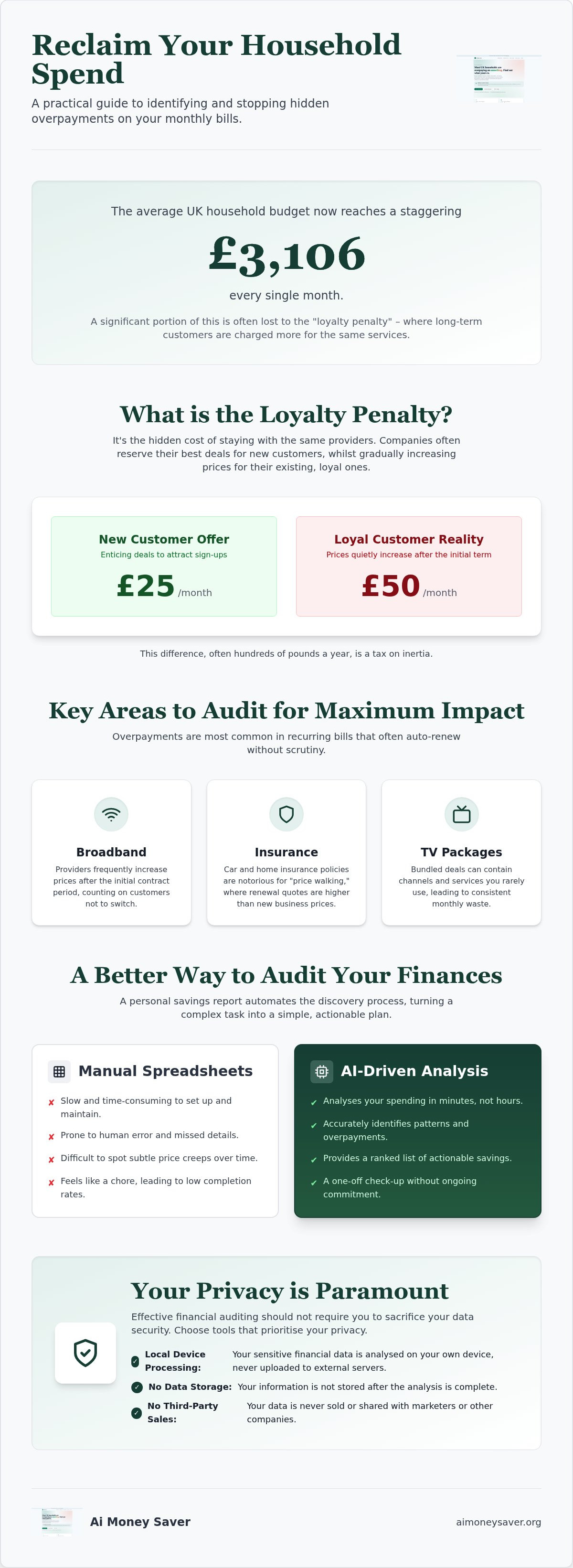
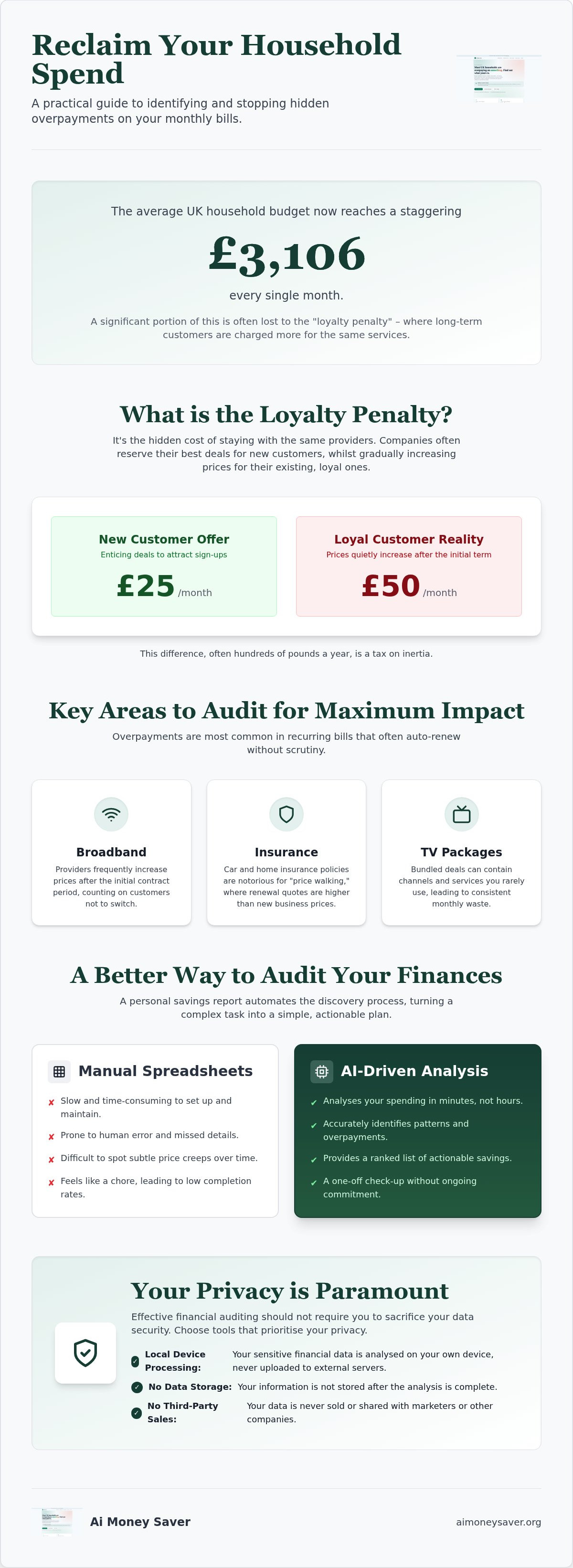
The average UK household budget now reaches £3,106 every single month. Much of this is essential, but a significant portion is often lost to the "loyalty penalty" on broadband and insurance. If you stay with the same providers year after year, you're likely overpaying by hundreds of pounds. A personal savings report UK offers a pragmatic way to identify these hidden leaks without the need for complex spreadsheets or manual calculations.
It's easy to feel overwhelmed by confusing bank statements and the fear of data breaches when using new financial tools. You want to save money, but you don't want to hand over your privacy or sign up for another endless subscription. We agree that financial clarity shouldn't come with a side of anxiety or a recurring fee that defeats the purpose of saving in the first place.
This guide reveals how a one-off digital audit can reclaim your household spend in 2026. You'll learn how to access a ranked list of savings actions and a clear breakdown of overpaid utilities. We'll walk you through a low-cost, high-integrity health check that identifies exactly where your money goes while keeping your data strictly on your own device.
Key Takeaways
- Stop paying the "loyalty penalty" by auditing your recurring household bills. If you haven't switched providers recently, you are likely subsidising cheaper deals for new customers.
- Use a personal savings report UK to identify hidden overpayments across utilities, broadband, and insurance. This bespoke digital audit creates a ranked list of specific actions to reclaim your cash.
- Target high-impact areas like TV packages and car insurance. These often contain the largest price hikes that go unnoticed on standard bank statements.
- Prioritise your privacy by choosing tools that use local device processing. This ensures your sensitive financial data is never stored on external servers or sold to third parties.
- Start with a free initial assessment to see potential savings before committing to a full check-up. A one-off health check provides clarity without the burden of an ongoing subscription.
Why UK Households Need a Personal Savings Report in 2026
Most UK households are currently leaking cash. It isn't happening through big, reckless purchases. It happens through the quiet, unnoticed drain of recurring bills. A personal savings report UK serves as a bespoke audit of these outgoings. It identifies exactly where your money is being over-allocated to service providers who no longer offer you their best rates. Unlike a generic budget, this audit looks for the "monthly leak", the specific overpayments that have become part of your financial background noise.
The Reality of the Loyalty Penalty amongst UK Providers
In 2026, the loyalty penalty remains a stubborn reality for broadband and insurance customers. Firms often capitalise on your inertia. They offer enticing deals to new customers while quietly ratcheting up prices for existing ones. Auto-renewals are the primary tool here. A quiet price hike. A missed notification. A higher bill. If you don't actively intervene, your car insurance or home broadband will simply roll over at a higher cost. Over a twelve-month period, the cost of doing nothing often totals hundreds of pounds. It is a hidden tax on your time and attention.
Why Average Savings Ratios Do Not Reflect Your Wallet
National statistics often paint a misleading picture. You might read that the average household saving ratio is trending around 9 per cent, but this rarely matches the reality of your individual disposable income. Generic financial "rules" don't account for your specific mix of subscriptions, utility tariffs, and insurance premiums. An effective personal financial planning process starts with your actual data, not a national average. ONS data provides a bird's-eye view, but it cannot tell you if you are overpaying for a TV package you rarely watch.
The focus must shift from saving "what is left" at the end of the month to optimising what is spent throughout it. Identifying a £30 monthly overpayment on a broadband deal is far more effective than trying to cut back on small, daily comforts. A personalised audit removes the guesswork. It ensures that every pound leaving your account is working as hard as possible. By transitioning from passive spending to active optimisation, you reclaim control over your household cash without needing to change your lifestyle.
How to Organise a Personalised Audit of Your Finances
Organising a micro-audit of your household spend is more effective than watching macro-statistics. You need to see where your specific pounds are going. Many people look at reports on Family spending in the UK, but national trends won't fix a local leak. To start, you must gather every recurring outgoing. This includes utilities, insurance, and the small digital subscriptions that often go unnoticed. Once you have a list, compare your current rates against the wider market. If you are paying £50 for broadband while new customers pay £25, you've found an actionable overpayment. Rank these by ease. A five-minute phone call to switch a car insurance policy is a high-return action.
Manual Spreadsheet vs. AI-Driven Analysis
Manual tracking is slow. Most households stop doing it because it feels like a second job. You might miss a subtle price hike or a double-billing error. AI-driven analysis changes the rhythm of this task. It spots patterns and price creeps faster than any human eye. If you want a personal savings report UK that actually works, speed is essential. A digital tool can provide a ranked list of savings actions in minutes. It makes the process feel negligible rather than a burden. You can use a Bank Statement Check to see these results without the manual data entry.
Using Bank Statement Data to Identify Waste
Your bank statement is the ultimate source of truth. It doesn't lie about that forgotten gym membership or the streaming service you haven't opened in months. A comprehensive spend breakdown reveals exactly what you are paying for versus what you are using. Look for recurring amounts that don't match your usage. If you see a £15 monthly charge for a "premium" account you don't need, that's a quick win. A personal savings report UK uses this data to highlight waste. It turns a confusing list of transactions into a clear strategy. You stop guessing and start reclaiming. This isn't about cutting back on joy. It's about stopping the payment for things you don't even use.
Key Areas a Savings Report Should Target for Maximum Impact
A personal savings report UK identifies the specific categories where your cash is most vulnerable. It isn't enough to know you're spending too much. You need to know which contract to cancel and which provider to call first. Official UK household spending data shows that essentials like housing and transport consume the largest share of our income. However, the most negotiable leaks often hide in your digital services and insurance policies. These are the areas where inertia costs you the most.
Renegotiating Broadband and TV Packages
Broadband and TV packages are often the easiest wins. Most UK providers bake in a mid-contract price hike that triggers every April. If you ignore these notifications, your bill can climb by 8 per cent or more without any change in service. A thorough audit identifies these hikes. It helps you spot "zombie" channels or streaming add-ons you no longer watch. When you call providers like Sky or Virgin, don't guess. Use Quick Savings Scripts to state your case clearly. These scripts help you navigate the retention department, ensuring you receive the same rates offered to new customers. It's about being prepared before you pick up the phone.
Insurance and Utility Overpayments: Finding the Leaks
Insurance is a classic loyalty trap. Car, home, and pet insurance firms often rely on the fact that you'll let the policy auto-renew. A personal savings report UK flags these renewals before they happen. It prompts you to check your insurance band and compare it against the current market. In the 2026 energy market, staying on a standard variable utility tariff is often a mistake. While the market has stabilised compared to previous years, fixed-rate deals are returning. If your report shows you're on an SVT, switching could save you significant sums over the winter months.
Once you've reclaimed this cash, don't let it sit in a zero-interest current account. Make the money work. In August 2026, leading easy-access savings rates are around 4.55 per cent to 5.0 per cent. Accounts like Cahoot's Sunny Day Saver offer 5 per cent on balances up to £3,000. If you can lock the money away for a year, fixed rates are approximately 4.85 per cent. Reinvesting your found money into these high-interest accounts turns a one-off saving into a long-term financial gain. You've done the hard work of finding the leak; now make sure the bucket stays full.
Privacy and Security in Financial Auditing Tools
Financial data breaches are a growing risk in the UK. Many consumers now hesitate before linking their bank accounts to new digital tools. It's a sensible reaction. If your data sits on a central server, it becomes a target for hackers. A personal savings report UK must address these fears with direct, transparent security measures. The goal is clarity without compromise. You should be able to audit your household spend without worrying about who else might see the results. In 2026, the distinction between "cloud-stored" and "device-only" analysis has become a critical factor for savvy UK consumers.
The Importance of Local Data Processing
Local processing is the gold standard for financial privacy. Modern technology allows AI to run assessments directly on your own phone or laptop. This means your sensitive information never leaves your device. You don't need to upload your bank password or primary credentials to a third-party server. This eliminates the risk of your data being caught in a large-scale cloud breach. Once the analysis is complete, the data is deleted instantly. It's a "one and done" process. You get the insights you need, and the digital footprint is erased immediately. This provides a level of reassurance that traditional banking apps often fail to deliver. It is the difference between sending your files to a stranger's warehouse and checking them in your own living room.
Avoiding the Trap of Subscription-Based Monitoring
Many "free" budgeting tools come with a hidden cost. They often rely on selling your aggregated spending data to third parties or pushing you into expensive monthly subscriptions. This creates a persistent link between your finances and a company's database. Avoiding a subscription model reduces your long-term data footprint. A one-off audit serves as a tactical check-up rather than a permanent surveillance tool. It stops "app fatigue" and keeps you in control of your own information. You pay a small, single fee for the service and receive immediate value without ongoing obligations. This pragmatic approach ensures that you are the only person who benefits from the audit. If you value your privacy, you can start your Personalised Savings Report to identify overpayments without the risk of persistent tracking.
Getting Started with Your Ai Money Saver Report
You've identified the "loyalty penalty" and you know the "monthly leak" is real. Now, you need a specific plan to stop it. A personal savings report UK provides this roadmap. It isn't a generic advice column or a collection of national statistics. It is a data-driven audit of your actual household outgoings. You can begin with a free initial assessment to see exactly where your potential savings lie. This initial glimpse ensures you see the value before making any commitment.
The Three-Step Assessment Process
The journey starts by identifying your main spending categories. You choose the method that fits your comfort level and your schedule. You can use a structured questionnaire to input your known costs or opt for a Bank Statement Check. This allows the AI to perform a local analysis of your transactions to find things you might have missed. If you prefer a conversational style, the Money Coach Assessment provides a human-like touch. It asks targeted questions to uncover hidden costs in areas like pet insurance or digital streaming bundles. The process is fast. Digital report generation happens in minutes. You don't have to wait for a manual review or a scheduled appointment. The AI works through the noise to find the facts immediately.
What Your £4.99 One-Off Report Includes
For a single £4.99 fee, you receive a full Personalised Savings Report. This is a one-time investment, roughly the cost of a single high-street coffee. There are no ongoing subscriptions or hidden obligations. You get a complete household spend breakdown that shows exactly where your money goes. More importantly, you receive a list of ranked savings actions. These are tailored to your specific providers and habits. If switching your broadband offers a £300 annual return for ten minutes of effort, it sits at the top of your list. You know exactly which task to tackle first for the maximum impact on your wallet.
The report also includes Quick Savings Scripts. These tell you exactly what to say when negotiating with providers like Sky or Virgin. You don't have to guess how to ask for a better deal. You also receive direct links to the best high-interest savings accounts UK for 2026. As of August, this includes leading easy-access rates like the 5 per cent offered by Cahoot or the 4.55 per cent from Chip. You find the money, and then you find the best place to grow it. You stay in total control of the process from start to finish.
Stop the Monthly Leak Today
In 2026, household bills don't have to be a source of constant stress. You now understand how the "loyalty penalty" quietly drains your account and how simple it is to target easy wins like broadband and insurance. A personal savings report UK turns these vague worries into a specific, ranked list of actions. It moves you from passive spending to active optimisation with minimal effort.
This isn't a lifelong commitment or a data-sharing risk. You pay a single £4.99 fee for a one-off health check. Your sensitive information stays on your device; it is never stored on our servers. You receive the clarity you need for less than the price of a high-street lunch. It is a pragmatic, low-risk tool designed to put hundreds of pounds back into your monthly budget.
Get your Personalised Savings Report for a one-off £4.99
Take the first step towards a leaner, more efficient household budget. You've worked hard for your income; it's time to make sure it stays where it belongs.
Frequently Asked Questions
Is a personalised savings report better than a free budgeting app?
A personal savings report UK provides a tactical audit rather than a lifestyle habit. Most free apps focus on categorising where you spent money last month. This report focuses on where you are overpaying right now. It identifies the "loyalty penalty" that apps often miss. By using a one-off assessment, you avoid the data-sharing risks and subscription fees associated with traditional budgeting software.
How much can the average UK household save using this report?
Individual results depend on your current contracts, but identifying hundreds of pounds in annual overpayments is common. UK households often lose significant sums by staying on standard variable tariffs or out-of-contract broadband deals. The report provides a ranked list of these leaks. It allows you to see the exact return on your time before you pick up the phone to negotiate with providers.
Is it safe to upload my bank statement for analysis?
Safety is built into the process through local device processing. When you use the Bank Statement Check, the analysis happens entirely on your own hardware. Your private financial data is never sent to our servers or stored in the cloud. This method provides the gold standard of privacy. It ensures that your bank details remain yours alone, protected from the risk of external security breaches.
Do I have to pay a monthly subscription fee?
There are no monthly fees or recurring charges. We believe a financial health check should be a simple, one-off transaction. You pay a single £4.99 fee for your personalised report and that is the end of the commitment. This pragmatic approach ensures you keep every penny of the savings you identify. It is a straightforward tool for a specific job, not another monthly bill to manage.
What bills are included in the household budget assessment?
The assessment targets the most common areas where UK households overpay. This includes your broadband and TV bundles, car and home insurance, and utility tariffs. We also look for "zombie" subscriptions like forgotten gym memberships or streaming services you no longer use. By auditing these specific recurring outgoings, the report identifies the easiest wins for reclaiming your cash and improving your monthly disposable income.
Can the report help me find better ISA rates in the UK?
We provide links to the latest market-leading rates to help you reinvest your savings. For instance, top easy-access accounts currently offer between 4.55% and 5.0%. Whilst we do not provide regulated financial advice, we show you how to move your reclaimed cash into high-interest accounts. This ensures that the money you've saved from bills starts earning a meaningful return immediately in a secure environment.
How does the AI money coach assessment work?
The AI money coach assessment works through a series of targeted, interactive questions. It mimics a professional audit by looking for quiet drains on your budget that you might overlook. This personal savings report UK tool identifies specific patterns in your recurring bills and provides custom scripts for renegotiation. It is designed to be fast and efficient, moving you from a confusing statement to a clear action plan in minutes.
What happens to my data after the report is generated?
Your data is erased the moment your report is generated. We have a strict policy against data persistence and we do not store any of your transaction history on our systems. This lack of a long-term data footprint is a core part of our security promise. You get the clarity of a professional audit without the risk of ongoing tracking or your information being sold to third parties.
Frequently Asked Questions
A personal savings report UK provides a tactical audit rather than a lifestyle habit. Most free apps focus on categorising where you spent money last month. This report focuses on where you are overpaying right now. It identifies the "loyalty penalty" that apps often miss. By using a one-off assessment, you avoid the data-sharing risks and subscription fees associated with traditional budgeting software.
Individual results depend on your current contracts, but identifying hundreds of pounds in annual overpayments is common. UK households often lose significant sums by staying on standard variable tariffs or out-of-contract broadband deals. The report provides a ranked list of these leaks. It allows you to see the exact return on your time before you pick up the phone to negotiate with providers.
Safety is built into the process through local device processing. When you use the Bank Statement Check, the analysis happens entirely on your own hardware. Your private financial data is never sent to our servers or stored in the cloud. This method provides the gold standard of privacy. It ensures that your bank details remain yours alone, protected from the risk of external security breaches.
There are no monthly fees or recurring charges. We believe a financial health check should be a simple, one-off transaction. You pay a single £4.99 fee for your personalised report and that is the end of the commitment. This pragmatic approach ensures you keep every penny of the savings you identify. It is a straightforward tool for a specific job, not another monthly bill to manage.
The assessment targets the most common areas where UK households overpay. This includes your broadband and TV bundles, car and home insurance, and utility tariffs. We also look for "zombie" subscriptions like forgotten gym memberships or streaming services you no longer use. By auditing these specific recurring outgoings, the report identifies the easiest wins for reclaiming your cash and improving your monthly disposable income.
We provide links to the latest market-leading rates to help you reinvest your savings. For instance, top easy-access accounts currently offer between 4.55% and 5.0%. Whilst we do not provide regulated financial advice, we show you how to move your reclaimed cash into high-interest accounts. This ensures that the money you've saved from bills starts earning a meaningful return immediately in a secure environment.
The AI money coach assessment works through a series of targeted, interactive questions. It mimics a professional audit by looking for quiet drains on your budget that you might overlook. This personal savings report UK tool identifies specific patterns in your recurring bills and provides custom scripts for renegotiation. It is designed to be fast and efficient, moving you from a confusing statement to a clear action plan in minutes.
Your data is erased the moment your report is generated. We have a strict policy against data persistence and we do not store any of your transaction history on our systems. This lack of a long-term data footprint is a core part of our security promise. You get the clarity of a professional audit without the risk of ongoing tracking or your information being sold to third parties.